See what minimally invasive and robotic heart surgery actually mean.
Research by Yevhenii Kozlov · Co-Founder of BookimedUpdated 8 October 2026Sources linked throughout
At a glance
Smaller chest incisions can preserve the breastbone and reduce the initial recovery burden for selected operations. The benefit depends on the procedure: a smaller scar does not by itself mean a more durable repair or a faster return to full fitness.
5 versus 6 hospital days
The UK Mini Mitral trial compared 330 adults having degenerative mitral repair through minithoracotomy or sternotomy.
Free Bookimed support. Compare options before deciding.
Benefits and trade-offs
Potential advantages
Potential gains include a smaller scar and less initial disruption. MIST also found better one-month physical-recovery scores after small-thoracotomy CABG in selected patients.
Limited access must still allow the complete operation. Major cardiac-surgery risks remain, and the method may be unsuitable for some anatomy or combined procedures.
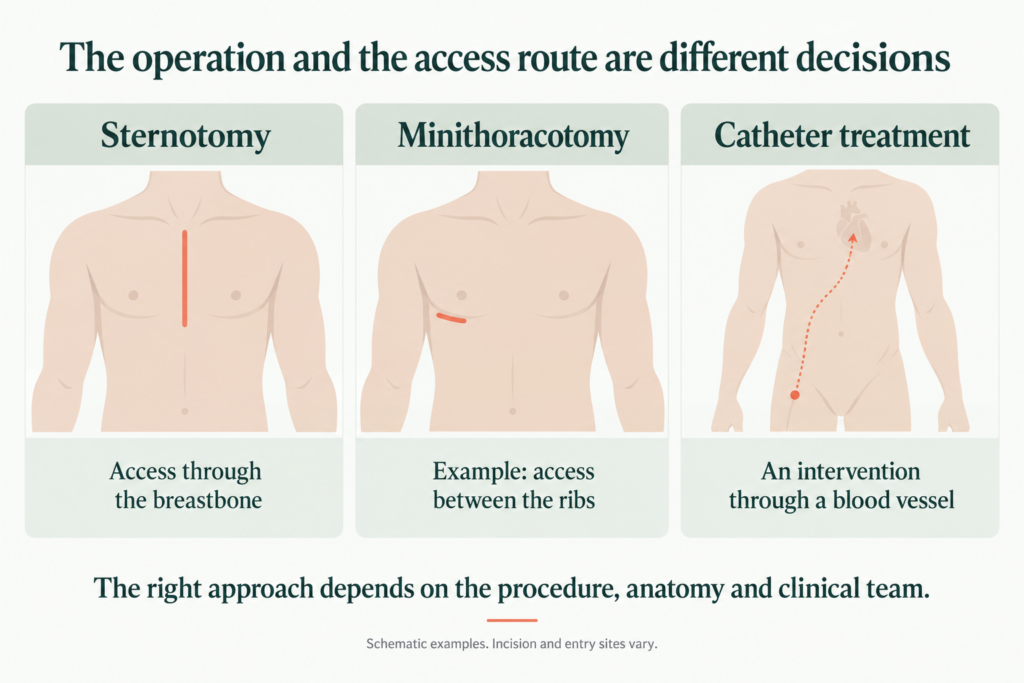
Open, minimally invasive, robotic and catheter approaches
Approach
Potential advantage
Important limit
Sternotomy
Broad access for cardiac work and combined procedures
The breastbone is divided and requires healing
Mini-sternotomy
More limited breastbone opening
Still involves bone healing and does not suit every procedure
Minithoracotomy
Access between the ribs without a full breastbone opening
Anatomy, exposure and associated procedures determine feasibility
Robot-assisted surgery
Surgeon-controlled precision instruments through limited chest access
Depends on a trained team and a suitable operative plan
Catheter treatment
Reaches the treatment site through blood vessels
Treats selected conditions; it is not a substitute for every surgical repair
AI-generated schematic, not an operative plan. Sites vary by procedure. Tap to enlarge. The descriptions above and the linked clinical sources provide the full explanation.
Mitral repair: what a randomized trial found about recovery
The UK Mini Mitral randomized trial enrolled 330 adults undergoing repair for degenerative mitral regurgitation at 10 UK centres. Expert surgeons performed either minithoracotomy or conventional sternotomy.
Median hospital stay was five versus six days. The trial did not find superiority for the primary measure of physical function at 12 weeks. These results describe mitral repair in this study; they are not a comparison of every robotic operation or every surgeon.
UK Mini Mitral randomized trial · 330 adults
5days · minithoracotomy
6days · sternotomy
Median postoperative hospital stay. The primary physical-function outcome at 12 weeks did not show superiority for minithoracotomy. Degenerative mitral repair, performed by expert surgeons.
Benefits, risks and possible conversion to open surgery
Smaller access can reduce scarring and selected early recovery burdens. In the mitral trial, the measurable gain was one fewer median hospital day; the primary 12-week functional result was not superior.
Heart-lung support may still be needed. A larger incision can become necessary for exposure or safety, and major cardiac-surgery risks remain.
Different approaches for CABG, valve disease and HCM
The important correction differs by diagnosis: CABG must revascularize the required coronary territories; mitral surgery must provide a durable repair or replacement; HCM surgery must relieve the relevant obstruction and any contributing mitral abnormalities. An access technique does not replace those goals.
Hisar advertises a $20,000 robotic CABG package with seven hospital days. Cui’s HCM programme has a $25,000–40,000 estimated programme cost. These are different operations, not two prices for the same treatment.
Hospital allowances, additional ICU days and unplanned procedures can affect the total. A package’s hotel duration does not establish fitness to fly.
Explore each specialist’s clinical focus, current programme and the studies relevant to this treatment. The listed roles include cardiac surgeons and, where appropriate, interventional cardiologists.
Daniel Swistel · Joshua Scheinerman NYU Langone Hypertrophic Cardiomyopathy Program
An HCM team that treats septal and mitral causes of obstruction, with conventional and selected robotic surgical approaches.
Quote on request
Individual estimate after assessment.
NYU reports more than 600 myectomies at programme level. Supporting method evidence includes a historical 77-patient anatomy study and a separate first robotic case report.