Durham, North Carolina, United States · Aortic reconstruction, transplantation and mechanical support
Research by Yevhenii Kozlov · Co-Founder of BookimedUpdated 8 October 2026Sources linked throughout
At a glance
Duke combines cardiac and vascular aortic expertise with an advanced heart-failure service. Hughes’s team covers the root through the thoraco-abdominal aorta; Schroder’s surgical remit includes transplantation, LVAD, ECMO and total artificial heart.
Aortic continuity of care
The centre describes imaging, genetics and lifelong surveillance alongside open and endovascular treatment.
Your diagnosis, selected specialist and treatment priorities.
Clinical benefits and limitations
Potential advantages
Aortic disease can be managed across cardiac and vascular disciplines, while a separate service offers transplant and temporary or durable circulatory support.
The HAART findings concern one internal-ring technique, not every Duke repair. Schroder’s donor-heart trial is multicentre evidence with six-month follow-up, not the hospital’s overall transplant survival rate.
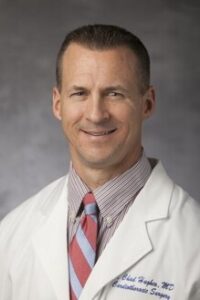
G. Chad Hughes’s Duke practice covers aortic valve repair, valve-sparing root replacement and disease extending to the arch and thoraco-abdominal aorta. His team has also published late limitations of a specific repair device.
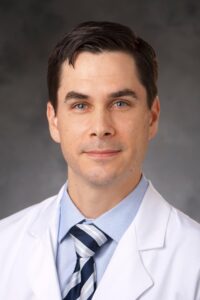
Jacob Schroder leads surgical advanced heart-failure care at Duke. His remit connects heart transplantation with durable LVADs, temporary ECMO and total artificial-heart care, addressing different degrees and durations of circulatory support.
Hughes coauthored a 71-patient HAART-ring repair series. At mean follow-up of 3.9 years, 11 patients had at least moderate regurgitation, all with trileaflet valves; four needed reoperation, including three for ring dehiscence.
How to interpret this: The authors urged caution with this subannular approach in trileaflet valves. This device-specific cohort should not be generalized to all Duke aortic surgery or all valve-sparing techniques; it is not an individual risk estimate.
The 2023 multicentre randomized trial led by Schroder met its noninferiority endpoint for risk-adjusted survival six months after transplantation using the studied DCD/perfusion pathway.
How to interpret this: Primary analysis was as treated. Selected donors, recipients and equipment limit generalization; this is not a personal survival rate, universal eligibility rule or long-term equivalence claim.