Mitral valve repair surgeon rankings: experience, methods and results
5 surgical teams · 3 clinical studies · expertise, methods and reported experience.
Research by Yevhenii Kozlov · Co-Founder of BookimedUpdated 8 October 2026Sources linked throughout
At a glance
Compare mitral valve repair surgeons and programmes by the operations they offer, relevant experience and clinical results. Each team has one card, with its studies grouped underneath. Reported practice totals carry their source; study samples stay beside their own results.
5 teams · 3 studies
One card per surgical team. Clinical studies remain separate inside each card, with their own dates and results.
Free Bookimed support. Compare options before deciding.
Mitral valve repair surgeons and specialist teams
Compare reported surgical experience
Positions use published operation counts within the same procedure, reporting period and attribution. “+” is a reported minimum. Personal operations, participation and programme totals have separate lists. A dash means open-ended counts do not establish an exact place. The lists compare experience, not safety or suitability.
2 specialists or programmes with comparable public figures in this researched shortlist. Source dates and the exact operation scope are shown beside each figure.
1
A. Marc Gillinov / Cleveland Clinic programmeIsolated mitral valve repair or replacement; all approaches. Calculated from 447 repairs + 167 replacements in the same isolated-procedure table.
614Calendar year 2025 · published 2026-03-16 · counting date 2025-12-31Source ↗ · read 2026-10-08
171Calendar year 2025 · counting date 2025-12-31Source ↗ · read 2026-10-08
Cards follow the selected procedure’s default experience comparison above. Providers without a comparable public count retain their clinical profiles without a numbered position.
Specialist expertiseMitral repair
A. Marc Gillinov
Cleveland Clinic programme
#1 · Programme operations · 2025 · isolated mitral valve operations · among 2 with comparable public figures
A learning-curve comparison inside one robotic programme.
Reported stroke fell from 2.0% in the first 500 cases to 0.8% in the second 500. This is an unadjusted time comparison, not proof that volume alone caused the change.
A learning-curve comparison inside one robotic programme.
1000 robotic mitral operations in this study
2006–2013 · published 2017/2018
Reported stroke fell from 2.0% in the first 500 cases to 0.8% in the second 500. This is an unadjusted time comparison, not proof that volume alone caused the change.
Results: 992/997 attempted repairs completed; 915/935 with predischarge echo had no or mild MR. Hospital mortality 1/1,000; stroke 14/1,000.
Follow-up: Hospital and early results, not a long-term durability study.
Study context: Institutional series; Gillinov is first author, without per-surgeon case allocation. The current official programme also names Per Wierup. The cohort comprised patients screened for robotic surgery. Historical programme results do not establish a current individual surgeon’s outcomes.
A cohort focused on complex multisegment Barlow valves.
124/124 initial repairs completed, with no conversion to sternotomy or valve replacement reported. These were selected Barlow cases within a larger robotic programme.
A cohort focused on complex multisegment Barlow valves.
124 Barlow disease patients in this study
2015–2022 · published 2023
124/124 initial repairs completed, with no conversion to sternotomy or valve replacement reported. These were selected Barlow cases within a larger robotic programme.
Results: Freedom from reoperation/additional intervention 99.2% over reported follow-up; postoperative stroke 1/124. This is not a 10-year recurrent-leakage endpoint.
Follow-up: Reported as 36 ± 21 months; the paper calls this “median” despite that notation. Six-month echo available in 116/124.
Study context: Programme team series; no per-surgeon case allocation. The official institute lists Watanabe, Ishikawa and Seguchi. Early one-week MR counts conflict between abstract and body, so they are omitted here. Zero reported conversions does not mean zero risk.
Durability separated by which leaflet is diseased.
Ten-year freedom from more-than-2+ MR or reintervention: 92.4% for posterior prolapse versus 84.3% for anterior/bileaflet prolapse (competing-risk estimates).
Durability separated by which leaflet is diseased.
850 degenerative robotic mitral cases in this study
2005–2020 · published 2021/2022
Ten-year freedom from more-than-2+ MR or reintervention: 92.4% for posterior prolapse versus 84.3% for anterior/bileaflet prolapse (competing-risk estimates).
Results: Baseline groups: 582 posterior and 268 anterior/bileaflet. 95% confidence intervals: 85.5–96.7% and 73.9–92.2%, respectively.
Follow-up: Median clinical follow-up 5.5 years; median echo follow-up 1.7 years. Not every patient was observed for 10 years.
Study context: Trento performed 788/850 (92.7%) operations; three other surgeons performed 62. Outcomes are pooled, not Trento-only. Selected degenerative robotic cohort excluding calcification, failed transcatheter repair and endocarditis. Historical operator attribution does not establish present booking availability.
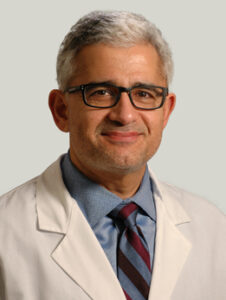
Husam Balkhy leads robotic cardiac surgery at UChicago Medicine. His named CABG technique is totally endoscopic beating-heart bypass, including selected multivessel and hybrid procedures.
Joanna Chikwe chairs cardiac surgery at Cedars-Sinai’s Smidt Heart Institute. Her coauthored studies distinguish routine degenerative prolapse from complex Barlow disease and follow recurrent leakage as well as repair completion.
Procedure-specific evidence makes differences in technique, anatomy and observation period visible before comparing teams.
Trade-offs and limits
These studies are not a matched comparison of the listed surgeons. Personal treatment suitability and risk require clinical assessment.
How to read the comparison
Recruitment dates describe when operations took place; follow-up describes how long patients were observed. Both remain visible beside each study.
Complication and outcome definitions differ. Counts are not pooled, programme cohorts are not automatically personal surgeon totals, and smaller incisions are not treated as proof of better outcomes.