Sleeve gastrectomy: a guide to gastric sleeve surgery abroad · Decision guide
Sleeve gastrectomy: a guide to gastric sleeve surgery abroad
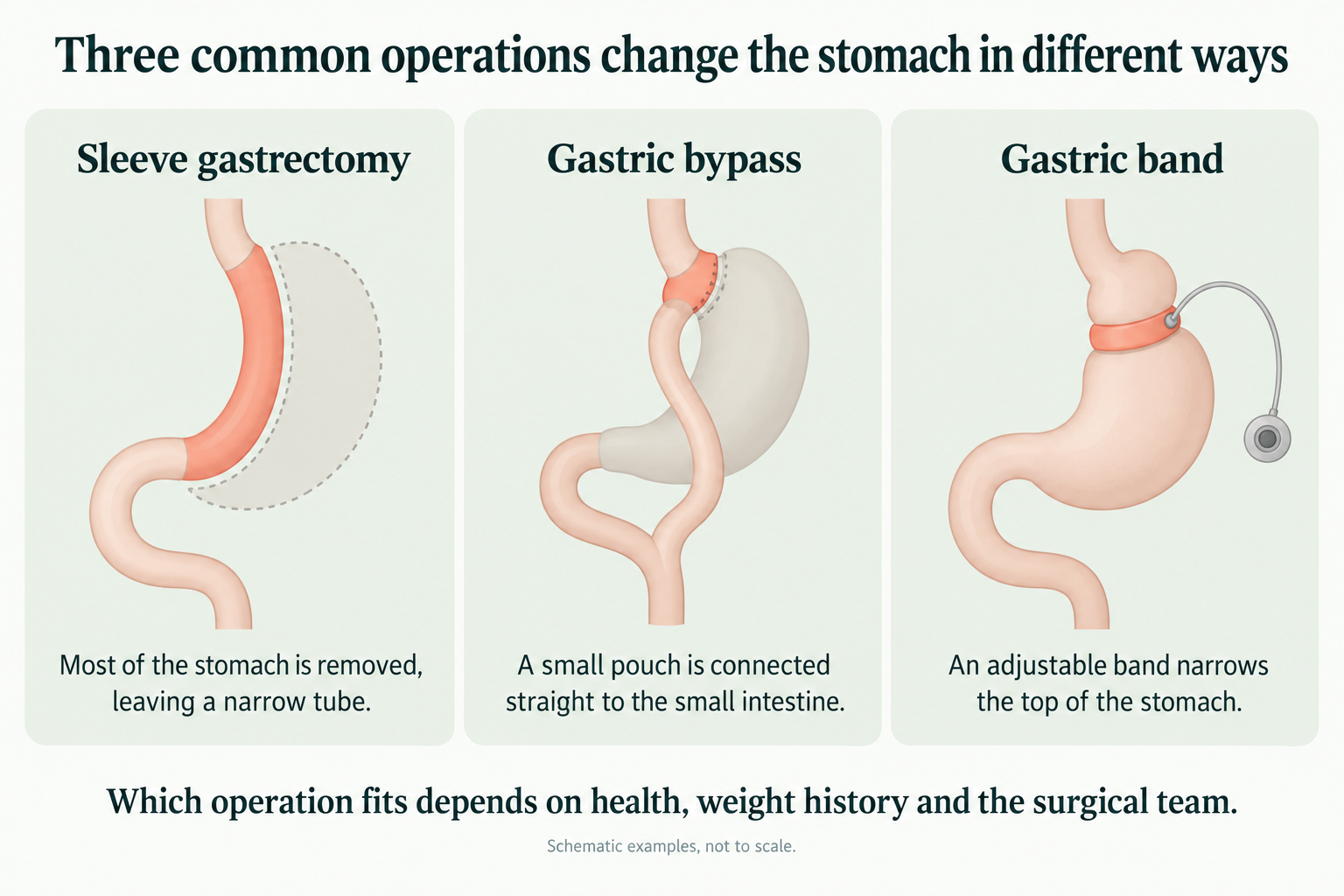
Sleeve gastrectomy, also called gastric sleeve surgery, removes much of the stomach and leaves a smaller, tube-shaped stomach.
Free Bookimed support. Compare options before deciding.
What it is
Sleeve gastrectomy, also called gastric sleeve surgery, removes much of the stomach and leaves a smaller, tube-shaped stomach. It limits how much food the stomach holds and can reduce hunger. This is an operation that removes stomach tissue, rather than an endoscopic treatment that reshapes the stomach from inside. [1]
Sources (1)
Who it is for — and when another approach may fit better
Body mass index, or BMI, relates weight to height. A 2022 international guideline from the American Society for Metabolic and Bariatric Surgery and the International Federation for the Surgery of Obesity recommends weight-loss surgery for adults with a BMI of at least 35, whether or not they already have an obesity-related illness. This is eligibility for a surgical assessment, not an automatic recommendation for sleeve rather than another operation. [2]
The same guideline supports considering surgery at BMI 30–34.9 when nonsurgical treatment has not produced substantial, lasting weight loss or improvement in related illnesses. A 2024 international expert consensus also supports surgery for people with type 2 diabetes and BMI of at least 30, with sleeve among the possible procedures. Type 2 diabetes is a condition in which blood sugar stays too high because the body does not use insulin effectively. [3][4]
BMI is not the whole assessment. The international guideline notes that diabetes and cardiovascular disease can occur at a lower BMI in Asian populations. A bariatric team — specialists in obesity surgery, nutrition and related care — considers health problems and treatment history as well as body size. [5]
Sleeve is not a good choice to make on price alone, especially with troublesome reflux: stomach contents flowing back into the food pipe and causing heartburn or regurgitation. A recent review found that sleeve can cause new reflux or make existing reflux worse. Severe reflux warrants a discussion of gastric bypass instead; an international sleeve consensus supports conversion to bypass when severe reflux persists after sleeve despite adequate weight loss. [7][8]
Surgery may need to wait while the team addresses active substance misuse, severe uncontrolled mental illness or disordered eating. The international guideline calls for assessment and treatment of these issues before surgery; it does not treat every history of depression or eating difficulties as an automatic exclusion. Readiness for the changes after surgery matters alongside medical fitness. [9]
Sources (4)
- 2022 American Society of Metabolic and Bariatric Surgery (ASMBS) and International Federation for the Surgery of Obesity and Metabolic Disorders (IFSO) Indications for Metabolic and Bariatric Surgery.
- How does bypass compare with sleeve for reflux?
- Can sleeve cause or worsen reflux?
- Sixth international consensus conference on sleeve gastrectomy.
Results to expect
Weight loss can last, but the amount varies and some weight can return. It helps to distinguish total weight loss — the share of starting body weight lost — from excess weight loss, which measures the share lost above a reference healthy weight. These measures are not interchangeable. A personal forecast needs to take account of starting weight, health conditions and follow-up care, rather than treating a study average as a promise. [10][11]
A large 2026 UK randomized trial, in which patients were assigned to operations by chance, offers a useful comparison. At 3 years after assignment, 41.5% of the sleeve group with an assessable weight outcome had lost at least 50% of their excess weight: 142 of 342 people. This does not mean that they lost half of their starting body weight. The equivalent result in the bypass group was 68.1%. The study clock started at assignment, not surgery, and the pandemic disrupted some operations and follow-up visits. [12]
For the longer view, a 2026 meta-analysis — a review that combines study results — included 40 studies and 51,055 people across its different treatment groups. It reported a BMI reduction of 11.0 points at 10 years after sleeve. This is a BMI change, not an 11% weight loss, and the full review population was not all sleeve patients. The finding supports lasting benefit without predicting an individual result. [14]
For planning, useful consultation questions are: “What weight range is realistic for me at 1 year and at 5 years?” and “What support is available if weight returns?” A 2026 society statement describes obesity treatment after surgery as ongoing care: medication, further procedures and nutritional or behavioural support may all have a role when weight loss is insufficient or weight returns. [16]
Diabetes can improve, but sleeve is not a guaranteed cure. A 2026 meta-analysis of randomized trials found that bypass was more likely than sleeve to achieve diabetes remission at 1 and 3 years. Remission describes diabetes coming under control according to a study’s criteria; those criteria differ between studies. The difference between operations at 5 years was not statistically clear, which does not establish that their effects are identical. [17]
Improvement in high blood pressure may also fade. The long-term 2026 review found that the proportion of sleeve patients with hypertension — high blood pressure — returned to its starting level by 10 years, although the review described the blood-pressure evidence as less robust. Continued medical follow-up matters even after substantial weight loss. [18]
Risks and side effects
Early risks
A leak means fluid escapes through the closed edge of the stomach. Bleeding is another early surgical complication. Both are assessed in comparative sleeve studies, and neither disappears because an operation uses small cuts or robotic assistance. A 2026 systematic review comparing robotic with standard laparoscopic sleeve found no clear safety advantage; the certainty of the evidence was very low. Laparoscopic surgery uses a camera and instruments through small cuts, while robotic surgery uses instruments controlled by the surgeon through a robotic system. [19]
Death around the operation is rare but possible. The 2022 international guideline reports a risk of 0.03%–0.2% across metabolic and bariatric surgery. That is a broad estimate across operations, not a sleeve-only rate or a prediction for a particular clinic. An individual risk discussion needs to consider the planned operation and the patient’s health. [21]
Blood-clot prevention is part of postoperative care. The Enhanced Recovery After Surgery society guideline recommends both physical prevention measures and medication, with the type and duration tailored to the patient. A trip abroad adds practical questions about the discharge plan, travel clearance and who provides help after returning home. [22]
Later problems
Reflux is an important trade-off alongside weight loss. A 2026 systematic review found changes in food-pipe function consistent with new or worsening reflux after sleeve, despite weight reduction. Its studies had important limitations, including small samples and short follow-up. A surgical-society guideline favours trying medical treatment before another operation for reflux after sleeve; severe persistent reflux can lead to discussion of bypass. [23][24][25]
Nutrient deficiencies can occur after weight-loss surgery. Deficiencies mean the body is getting too little of an essential vitamin or mineral. The recovery guideline identifies risks involving iron, folate and other vitamins and minerals, and recommends lifelong supplements and blood-test monitoring tailored to the operation. The fact that sleeve is not a bypass does not remove the need for nutritional follow-up. [26]
Persistent vomiting and poor intake deserve prompt contact with the treating team. The recovery guideline links these problems with a higher risk of thiamine deficiency — too little of a vitamin needed for nerve and energy function — and calls for immediate treatment when that deficiency is suspected. [28]
Further treatment is sometimes needed for reflux, insufficient weight loss or weight returning. A 2026 society statement supports an individual assessment rather than automatically repeating surgery. Options can include obesity medication, an endoscopic procedure performed through a flexible tube, or another operation. [29][30]
Sources (7)
- Does the latest prospective evidence differ?
- 2022 American Society of Metabolic and Bariatric Surgery (ASMBS) and International Federation for the Surgery of Obesity and Metabolic Disorders (IFSO) Indications for Metabolic and Bariatric Surgery.
- What happens to eating after surgery?
- Can sleeve cause or worsen reflux?
- Who may be better suited to sleeve?
- Sixth international consensus conference on sleeve gastrectomy.
- What is a revision and what are the alternatives?
Recovery and life after sleeve
Early recovery includes supervised movement and a gradual return to eating. A randomized sleeve trial studied a supported sequence of sitting, standing and walking soon after anaesthesia. The recovery guideline describes starting clear liquids within hours when appropriate, followed by nourishing fluids; the dietitian then guides changes in food texture according to the operation and the centre’s approach. This is not an immediate return to an unrestricted diet. [31][32]
Hospital nights and total time abroad are different. For example, the Bookimed package for  Burcin Batman at
 Hisar Hospital Intercontinental lists 2 hospital nights and 4 hotel nights, with approximately 7 days recommended in Istanbul. Those are that provider’s package terms, not a universal discharge or fit-to-fly timetable. [33]
Return to work also needs an individual decision. A package from  Kaplan Baha Temizgonul says work may resume 5–10 days after surgery if the doctor approves. This is a provider estimate, not a clinical guideline for every patient or type of work. The consultation can clarify the plan for a desk job, lifting, exercise and the return flight. [35]
Long-term care continues after the trip. The recovery guideline recommends lifelong vitamin and mineral supplementation and nutritional blood tests. Useful arrangements to settle before booking include a named local clinician, access to a bariatric dietitian, follow-up appointments and a clear route back to the surgical team if eating or reflux becomes difficult. [36][38]
How it compares with gastric bypass
Roux-en-Y gastric bypass creates a small stomach pouch and reroutes the passage of food through the intestine; sleeve reduces the stomach itself. The large UK randomized trial found greater weight-loss success with bypass, and the diabetes review favoured bypass for earlier remission. Reflux after sleeve is another reason to discuss bypass. These advantages do not make bypass the right operation for everyone: the choice also involves surgical risk, nutritional follow-up and the patient’s priorities.
Cost and booking on Bookimed
Recorded public package prices, according to the clinics. The median is the middle listed price, not a personal quote. Different procedures and inclusions are not directly comparable. Dates refer to the source collection, not a guarantee of price validity. Confirm the exact procedure, operator, hospital, exclusions and follow-up in a current itemised offer.
Sleeve
USD 2500.00–29187.00; median 6174.24 (79 packages; recorded 2026-10-21) Packages and sources
Compare specialists · Compare clinics
Compare 79 packages, clinics and price sources
Professor Dr. Samet Yardımcı Clinic · Turkey · USD 4000.00–5000.00 · 2 packages
- Laparoscopic Gastric Sleeve with 3 Nutritionist Meals — Transfer Included — USD 4000 Price source · Recorded 2026-10-21 (collection date; validity not supplied)
- Laparoscopic Gastric Sleeve — 5★ Hotel & VIP Transfer All-Inclusive Package — USD 5000 Price source · Recorded 2026-10-21 (collection date; validity not supplied)
Hisar Hospital Intercontinental · Turkey · USD 3893.00–3893.00 · 1 packages
- Premium Gastric sleeve surgery (Sleeve gastrectomy) All Included — USD 3893 Price source · Recorded 2026-10-21 (collection date; validity not supplied)
Meliva Kardiolita Hospital · Lithuania · USD 6300.00–8980.72 · 3 packages
- Gastric Sleeve Surgery by Professor with 200+ Annual Bariatric Surgeries at JCI-Accredited Hospital — USD 7659 Price source · Recorded 2026-10-21 (collection date; validity not supplied)
- Gastric sleeve surgery — USD 8980.72 Price source · Recorded 2026-10-21 (collection date; validity not supplied)
- Gastric sleeve — USD 6300 Price source · Recorded 2026-10-21 (collection date; validity not supplied)
KCM Clinic · Poland · USD 6735.54–6954.00 · 6 packages
- Gastric Sleeve Surgery ( Weight Loss Surgery ) At KCM Clinic 2026 Package 5990 Euro — USD 6735.54 Price source · Recorded 2026-10-21 (collection date; validity not supplied)
- Gastric Sleeve Surgery ( Weight Loss Surgery ) At KCM Clinic 2026 Package 6000 Euro — USD 6735.54 Price source · Recorded 2026-10-21 (collection date; validity not supplied)
- Laparoscopic Gastric Sleeve € 6 000 — USD 6735.54 Price source · Recorded 2026-10-21 (collection date; validity not supplied)
- Gastric Sleeve Surgery ( Weight Loss Surgery ) At KCM Clinic 2026 Package 6000 Euro — USD 6735.54 Price source · Recorded 2026-10-21 (collection date; validity not supplied)
- Gastric Sleeve Surgery ( Weight Loss Surgery ) At KCM Clinic 2026 Package 6000 Euro — USD 6735.54 Price source · Recorded 2026-10-21 (collection date; validity not supplied)
- Laparoscopic Gastric Sleeve € 6 000 — USD 6954 Price source · Recorded 2026-10-21 (collection date; validity not supplied)
Anadolu Medical Center · Turkey · USD 6406.00–7800.00 · 10 packages
- Da Vinci Gastric Sleeve Surgery — Individual Chamber & Transfer Included — USD 6406 Price source · Recorded 2026-10-21 (collection date; validity not supplied)
- Laparoscopic Gastric Sleeve Procedure — USD 7167 Price source · Recorded 2026-10-21 (collection date; validity not supplied)
- Bariatric Surgery Program – Anadolu Sağlık Merkezi — USD 6700 Price source · Recorded 2026-10-21 (collection date; validity not supplied)
- Bariatric Surgery Program – Anadolu Sağlık Merkezi — USD 7521.35 Price source · Recorded 2026-10-21 (collection date; validity not supplied)
- Bariatric Surgery Program – Anadolu Sağlık Merkezi — USD 7521.35 Price source · Recorded 2026-10-21 (collection date; validity not supplied)
- Bariatric Surgery Program – Anadolu Sağlık Merkezi — USD 7521.35 Price source · Recorded 2026-10-21 (collection date; validity not supplied)
- Bariatric Surgery Program – Anadolu Sağlık Merkezi — USD 7521.35 Price source · Recorded 2026-10-21 (collection date; validity not supplied)
- Bariatric Surgery Program – Anadolu Sağlık Merkezi — USD 7521.35 Price source · Recorded 2026-10-21 (collection date; validity not supplied)
- Bariatric Surgery Program – Anadolu Sağlık Merkezi — USD 7521.35 Price source · Recorded 2026-10-21 (collection date; validity not supplied)
- Laparoscopic Sleeve Gastrectomy — USD 7800 Price source · Recorded 2026-10-21 (collection date; validity not supplied)
Atlas University Hospital · Turkey · USD 3300.00–3300.00 · 1 packages
- Premium Gastric Sleeve Surgery by Surgeon with 1,100+ Procedures — VIP Transfer — USD 3300 Price source · Recorded 2026-10-21 (collection date; validity not supplied)
Memorial Şişli Hospital · Turkey · USD 2500.00–5000.00 · 3 packages
- Gastric sleeve surgery (Sleeve gastrectomy) — USD 2500 Price source · Recorded 2026-10-21 (collection date; validity not supplied)
- Gastric Sleeve — USD 3500 Price source · Recorded 2026-10-21 (collection date; validity not supplied)
- Gastric sleeve surgery (Sleeve gastrectomy) — USD 5000 Price source · Recorded 2026-10-21 (collection date; validity not supplied)
Lokman Hekim Istanbul Hospital · Turkey · USD 2918.73–3367.77 · 10 packages
- Sleeve Gastrectomy Surgery Package -Limited Time Special Offer — USD 2918.73 Price source · Recorded 2026-10-21 (collection date; validity not supplied)
- Sleeve Gastroplasty Package — USD 3000 Price source · Recorded 2026-10-21 (collection date; validity not supplied)
- Sleeve Gastrectomy Surgery Package — USD 3087.12 Price source · Recorded 2026-10-21 (collection date; validity not supplied)
- Premium Sleeve Gastrectomy Surgery Package — USD 3087.12 Price source · Recorded 2026-10-21 (collection date; validity not supplied)
- Premium Sleeve Gastrectomy Surgery Package — USD 3087.12 Price source · Recorded 2026-10-21 (collection date; validity not supplied)
- Laparoscopic Gastric Sleeve Surgery- All Inclusive Package — USD 3087.12 Price source · Recorded 2026-10-21 (collection date; validity not supplied)
- Premium Sleeve gastrectomy- All Inclusive Package — USD 3367.77 Price source · Recorded 2026-10-21 (collection date; validity not supplied)
- Laparoscopic Gastric Sleeve Surgery- All Inclusive Package — USD 3087.12 Price source · Recorded 2026-10-21 (collection date; validity not supplied)
- Laparoscopic Gastric Sleeve Surgery- All Inclusive Package — USD 3367.77 Price source · Recorded 2026-10-21 (collection date; validity not supplied)
- Laparoscopic Gastric Sleeve Surgery- All Inclusive Package — USD 3367.77 Price source · Recorded 2026-10-21 (collection date; validity not supplied)
Büyük Anadolu Hospitals (BAH International) · Turkey · USD 3500.00–3500.00 · 1 packages
- Laparoscopic Gastric Sleeve by Surgeon with 20,000+ Bariatric Surgeries — VIP Package — USD 3500 Price source · Recorded 2026-10-21 (collection date; validity not supplied)
Digestive Surgery and Gastroenterology Specialist Centro PAD · Spain · USD 10114.00–10114.00 · 1 packages
- Laparoscopic Sleeve Gastrectomy for Obesity – Premium Package — USD 10114 Price source · Recorded 2026-10-21 (collection date; validity not supplied)
Turan Turan Health Group · Turkey · USD 4950.00–4950.00 · 1 packages
- Sleeve Gastrectomy (Gastric Sleeve) Surgery for Weight Loss — USD 4950 Price source · Recorded 2026-10-21 (collection date; validity not supplied)
Robotic Surgery Center in St. Zdislava Hospital · Czech Republic · USD 5600.00–8487.00 · 12 packages
- SLEEVE GASTRECTOMY – NEW TENDENCE IN SURGICAL TREATMENT OF OBESITY — USD 5600 Price source · Recorded 2026-10-21 (collection date; validity not supplied)
- SLEEVE GASTRECTOMY – NEW TENDENCE IN SURGICAL TREATMENT OF OBESITY — USD 8307.16 Price source · Recorded 2026-10-21 (collection date; validity not supplied)
- SLEEVE GASTRECTOMY – NEW TENDENCE IN SURGICAL TREATMENT OF OBESITY — USD 8307.16 Price source · Recorded 2026-10-21 (collection date; validity not supplied)
- SLEEVE GASTRECTOMY – NEW TENDENCE IN SURGICAL TREATMENT OF OBESITY — USD 8307.16 Price source · Recorded 2026-10-21 (collection date; validity not supplied)
- SLEEVE GASTRECTOMY – NEW TENDENCE IN SURGICAL TREATMENT OF OBESITY — USD 8307.16 Price source · Recorded 2026-10-21 (collection date; validity not supplied)
- SLEEVE GASTRECTOMY – NEW TENDENCE IN SURGICAL TREATMENT OF OBESITY — USD 8307.16 Price source · Recorded 2026-10-21 (collection date; validity not supplied)
- SLEEVE GASTRECTOMY – NEW TENDENCE IN SURGICAL TREATMENT OF OBESITY — USD 8307.16 Price source · Recorded 2026-10-21 (collection date; validity not supplied)
- SLEEVE GASTRECTOMY – NEW TENDENCE IN SURGICAL TREATMENT OF OBESITY — USD 8307.16 Price source · Recorded 2026-10-21 (collection date; validity not supplied)
- SLEEVE GASTRECTOMY – NEW TENDENCE IN SURGICAL TREATMENT OF OBESITY — USD 8307.16 Price source · Recorded 2026-10-21 (collection date; validity not supplied)
- SLEEVE GASTRECTOMY – NEW TENDENCE IN SURGICAL TREATMENT OF OBESITY — USD 8307.16 Price source · Recorded 2026-10-21 (collection date; validity not supplied)
- SLEEVE GASTRECTOMY – NEW TENDENCE IN SURGICAL TREATMENT OF OBESITY — USD 8307.16 Price source · Recorded 2026-10-21 (collection date; validity not supplied)
- SLEEVE GASTRECTOMY – NEW TENDENCE IN SURGICAL TREATMENT OF OBESITY — USD 8487 Price source · Recorded 2026-10-21 (collection date; validity not supplied)
Hospital de la Familia · Mexico · USD 4350.00–4350.00 · 3 packages
- GASTRIC SLEEVE — USD 4350 Price source · Recorded 2026-10-21 (collection date; validity not supplied)
- GASTRIC SLEEVE — USD 4350 Price source · Recorded 2026-10-21 (collection date; validity not supplied)
- GASTRIC SLEEVE — USD 4350 Price source · Recorded 2026-10-21 (collection date; validity not supplied)
Dr.Kaplan Baha Temizgonul · Turkey · USD 4944.00–5394.00 · 2 packages
- Laparoscopic Sleeve Gastrectomy by Surgeon with 900+ Bariatric Procedures Performed — USD 4944 Price source · Recorded 2026-10-21 (collection date; validity not supplied)
- Laparoscopic Sleeve Gastrectomy with Bariatric Team Support — All-Inclusive Package — USD 5394 Price source · Recorded 2026-10-21 (collection date; validity not supplied)
Lokman Hekim Akay Hospital · Turkey · USD 3294.00–3294.00 · 1 packages
- Premium Gastric Sleeve Surgery — 3 Nights Hospital & Hotel with Full Board — USD 3294 Price source · Recorded 2026-10-21 (collection date; validity not supplied)
Dr. Islam Abdelkhalek’s Clinic · Egypt · USD 3500.00–3500.00 · 1 packages
- Gastric Sleeve by Surgeon with 1,100+ Bariatric Surgeries — Hospital Stay Included — USD 3500 Price source · Recorded 2026-10-21 (collection date; validity not supplied)
Liv Bona Dea Hospital Baku · Azerbaijan · USD 3500.00–4000.00 · 2 packages
- Gastric Sleeve by Surgeon with 900+ Surgeries — 3 Meals by Nutritionist — USD 3500 Price source · Recorded 2026-10-21 (collection date; validity not supplied)
- Laparoscopic Gastric Sleeve Surgery at JCI-Accredited Hospital — Transfer Included — USD 4000 Price source · Recorded 2026-10-21 (collection date; validity not supplied)
Centro Médico Teknon · Spain · USD 16859.00–22451.79 · 4 packages
- Gastric Sleeve Surgery with Reduced-Pain Technique — JCI-Accredited Hospital — USD 16859 Price source · Recorded 2026-10-21 (collection date; validity not supplied)
- Teknon Medical Centre, Sleeve gastrectomy, Dr.Ballesta — USD 19084.02 Price source · Recorded 2026-10-21 (collection date; validity not supplied)
- Gastric sleeve surgery (Sleeve gastrectomy), leading specialist Dr.Ferrer Valls — USD 20206.61 Price source · Recorded 2026-10-21 (collection date; validity not supplied)
- Bariatric surgery — USD 22451.79 Price source · Recorded 2026-10-21 (collection date; validity not supplied)
Memorial Ataşehir Hospital · Turkey · USD 4200.00–6174.24 · 6 packages
- Gastric sleeve — USD 4200 Price source · Recorded 2026-10-21 (collection date; validity not supplied)
- Sleeve Gastrectomy — USD 4265.84 Price source · Recorded 2026-10-21 (collection date; validity not supplied)
- Sleeve Gastrectomy — USD 4328 Price source · Recorded 2026-10-21 (collection date; validity not supplied)
- Gastric Sleeve — USD 4400 Price source · Recorded 2026-10-21 (collection date; validity not supplied)
- Gastric Sleeve — USD 5400 Price source · Recorded 2026-10-21 (collection date; validity not supplied)
- Gastric Sleeve — USD 6174.24 Price source · Recorded 2026-10-21 (collection date; validity not supplied)
Memorial Antalya Hospital · Turkey · USD 3143.25–4490.36 · 2 packages
- gastric sleeve — USD 3143.25 Price source · Recorded 2026-10-21 (collection date; validity not supplied)
- gastric sleeve — USD 4490.36 Price source · Recorded 2026-10-21 (collection date; validity not supplied)
Ponderas Academic Hospital · Romania · USD 8428.00–9575.00 · 2 packages
- Laparoscopic Sleeve Gastrectomy with Double European/American Board Certification — USD 9575 Price source · Recorded 2026-10-21 (collection date; validity not supplied)
- Gastric Sleeve Surgery by Surgeon with 900+ Bariatric Surgeries at JCI Hospital — USD 8428 Price source · Recorded 2026-10-21 (collection date; validity not supplied)
Medical Park Antalya Hospital Complex · Turkey · USD 3800.00–3800.00 · 1 packages
- Laparoscopic Gastric Sleeve by Surgeon with 900+ Bariatric Surgeries Performed — USD 3800 Price source · Recorded 2026-10-21 (collection date; validity not supplied)
Memorial Bahçelievler Hospital · Turkey · USD 4153.58–4153.58 · 1 packages
- Gastric Sleeve — USD 4153.58 Price source · Recorded 2026-10-21 (collection date; validity not supplied)
Estexper Clinic · Turkey · USD 3929.00–3929.00 · 1 packages
- Standard Gastric sleeve surgery (Sleeve gastrectomy) All Included — USD 3929 Price source · Recorded 2026-10-21 (collection date; validity not supplied)
IRCCS OSPEDALE GALEAZZI – SANT’AMBROGIO · Italy · USD 19667.00–29187.00 · 2 packages
- Robotic Da Vinci Sleeve Gastrectomy by IFSO Member with 9,000+ Operations — Translation Included — USD 29187 Price source · Recorded 2026-10-21 (collection date; validity not supplied)
- Sleeve Gastrectomy by IFSO Member with 9,000+ Operations — Translation Included — USD 19667 Price source · Recorded 2026-10-21 (collection date; validity not supplied)
The selection includes laparoscopic and robotic sleeve packages; the range is not a single standardized bundle of services.
The sleeve surgeon catalogue and sleeve clinic catalogue provide the comparison routes. Package terms need to be checked individually: preoperative tests, anaesthesia, hospital and hotel stays, transfers, medicines, follow-up and care for complications are separate questions. A listed package price is not a personalized final total; Anadolu’s package explicitly notes that the plan and cost may change after medical assessment. [207]
Sources (75)
- Public package source
- Public package source
- Public package source
- Public package source
- Public package source
- Public package source
- Public package source
- Public package source
- Public package source
- Public package source
- Public package source
- Public package source
- Public package source
- Public package source
- Public package source
- Public package source
- Public package source
- Public package source
- Public package source
- Public package source
- Public package source
- Public package source
- Public package source
- Public package source
- Public package source
- Public package source
- Public package source
- Public package source
- Public package source
- Public package source
- Public package source
- Public package source
- Public package source
- Public package source
- Public package source
- Public package source
- Public package source
- Public package source
- Public package source
- Public package source
- Public package source
- Public package source
- Public package source
- Public package source
- Public package source
- Public package source
- Public package source
- Public package source
- Public package source
- Public package source
- Public package source
- Public package source
- Public package source
- Public package source
- Public package source
- Public package source
- Public package source
- Public package source
- Public package source
- Public package source
- Public package source
- Public package source
- Public package source
- Public package source
- Public package source
- Public package source
- Public package source
- Public package source
- Public package source
- Public package source
- Public package source
- Public package source
- Public package source
- Public package source
- Public package source
Next step
Use the Bookimed inquiry page to request an assessment and an itemized package for comparison. Useful questions for the team are: “Why sleeve rather than bypass for my health and reflux symptoms?”, “What results are realistic for me?”, “How are complications handled?”, and “Who will provide my follow-up after I return home?” A clinical review comes before the decision to have surgery; a package comparison helps organize that discussion, not replace it.
Request a treatment proposal
Turn information into your next step.
Free Bookimed support. Compare options before deciding.
Free Bookimed support. Compare options before deciding.