Gastric bypass: Roux-en-Y and mini bypass · Decision guide
Gastric bypass: Roux-en-Y and mini bypass
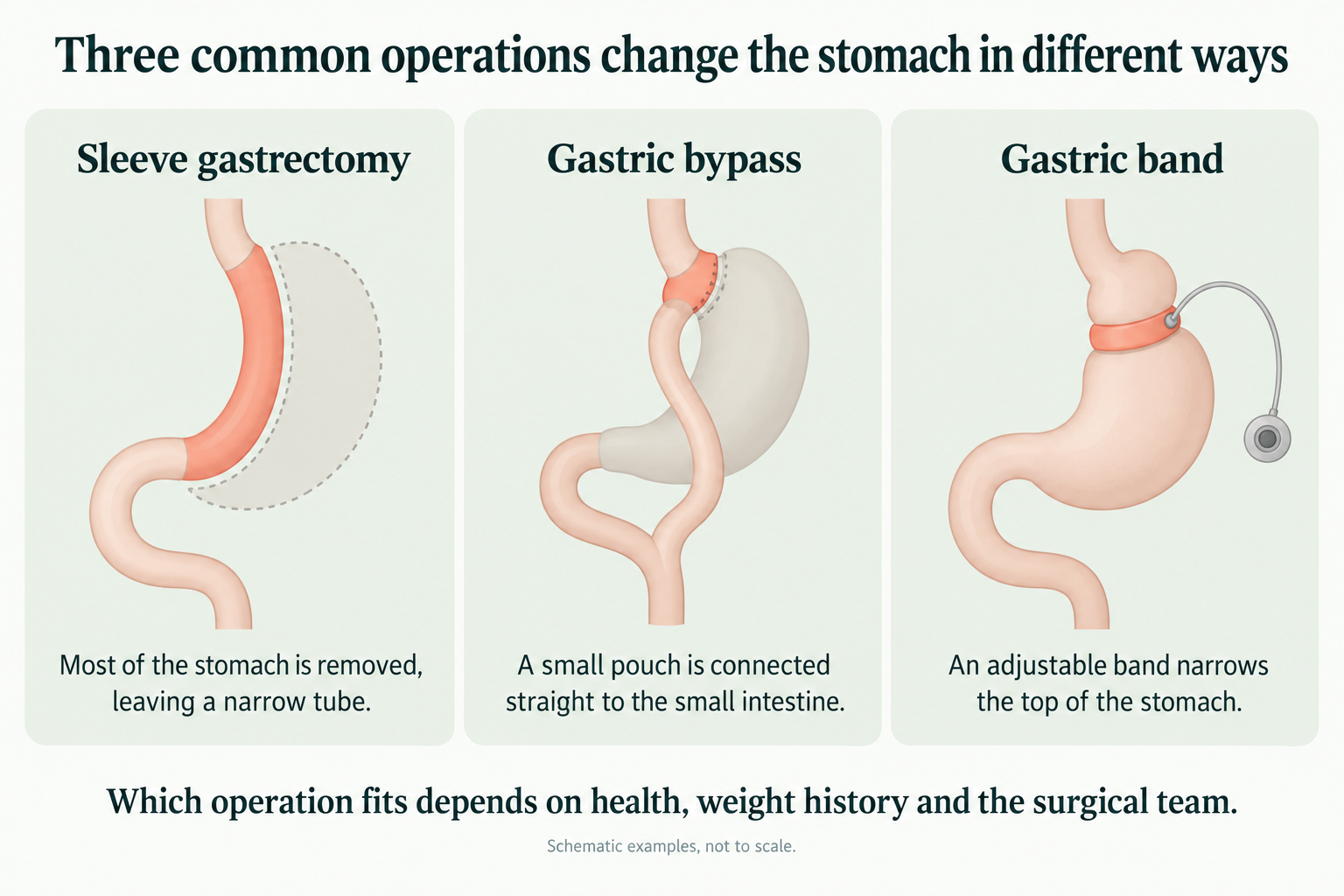
Gastric bypass creates a small stomach pouch and redirects food into the small intestine, bypassing part of the usual digestive route.
Free Bookimed support. Compare options before deciding.
What is gastric bypass?
Gastric bypass creates a small stomach pouch and redirects food into the small intestine, bypassing part of the usual digestive route. Roux-en-Y gastric bypass, or RYGB, keeps food and digestive juices on separate routes before they meet further along the intestine; one-anastomosis gastric bypass, or OAGB, connects a longer pouch to a loop of intestine. OAGB is also called “mini bypass”, but that name does not mean minor surgery or a smaller commitment to lifelong care. [1][2]
Who is it for, and who may need another option?
Body mass index, or BMI, relates weight to height. A 2022 international guideline recommends weight-loss surgery at a BMI of at least 35 kg/m², even without a diagnosed obesity-related illness. At BMI 30–34.9, surgery can be considered when nonsurgical treatment has not produced lasting weight loss or improvement in related conditions. These are criteria for assessment, not automatic approval for either bypass operation. [3]
The same guideline adjusts thresholds for Asian populations, offering surgery above BMI 27.5 kg/m². The assessment also considers diabetes, reflux, other illnesses, previous treatment and the risks of surgery. A surgeon and a wider care team decide whether bypass is appropriate, rather than selecting an operation from BMI alone. [5]
Bypass is not a ready-to-book solution while severe uncontrolled mental illness, active substance misuse or significant eating difficulties still need assessment and treatment. These issues call for support and a readiness review, not an automatic lifelong exclusion. A dietitian also checks nutritional deficiencies and prepares patients for changes in eating and follow-up. [8]
Inflammatory bowel disease, such as Crohn’s disease, can change the choice. A SAGES society guideline conditionally favors sleeve gastrectomy over Roux-en-Y in this group, while acknowledging limited evidence. Existing reflux and the ability to maintain nutritional care also matter when choosing between the bypass variants. [10][11][12]
Sources (4)
- 2022 American Society of Metabolic and Bariatric Surgery (ASMBS) and International Federation for the Surgery of Obesity and Metabolic Disorders (IFSO) Indications for Metabolic and Bariatric Surgery.
- Who may be better suited to sleeve?
- What is mini bypass weight loss at five years?
- How does bypass compare with sleeve for reflux?
Results to expect
Weight loss can be substantial and last for years, but the measurement matters. “Total weight loss” means the share of starting body weight lost. “Excess weight loss” means the share of weight above a study-defined reference weight lost; it is not the same percentage. Study averages are not a promise for an individual patient.
At 1 year, a 2026 exploratory analysis from a randomized trial found average losses of 33.1 kg after Roux-en-Y and 31.9 kg after mini bypass. The analysis involved 24 Roux-en-Y and 20 mini-bypass patients after an operative change in another participant. The difference was not statistically significant. This small study gives an example of results, not a reliable kilogram target for every starting weight. [13]
At 5 years, a 2026 systematic review and meta-analysis reported average excess weight loss of 75% after mini bypass. That estimate came from 11,296 patients, with very large differences between studies. It does not mean losing 75% of starting body weight. The evidence included both first operations and operations after earlier weight-loss surgery. [15]
For Roux-en-Y at 5 years, the same review summarizes a randomized trial reporting 71.4% excess BMI loss, compared with 75.6% after mini bypass. Excess BMI loss is the proportion of BMI above the study’s reference level that was lost. This is a trial result reported within a review, not the same pooled outcome as the mini-bypass figure above. [16]
At 10 years or longer, another 2026 systematic review of 5 retrospective studies, involving 1,750 mini-bypass patients overall, reported weighted average total weight loss of 31.1%. Retrospective studies look back at earlier treatment and are more vulnerable to selection and follow-up differences than randomized trials. The review also summarizes a separate Roux-en-Y cohort with average total weight loss of 23.5% at 10 years. These separate groups cannot establish that mini bypass gives better long-term results. [17]
Diabetes, high blood pressure and obstructive sleep apnea—repeated pauses in breathing during sleep—may improve. The mini-bypass review covering at least 5 years reported resolution in 80% of patients with diabetes, 61% with high blood pressure and 89% with sleep apnea. Definitions and follow-up differed, so these are not personal chances of a permanent cure or a reason to stop medication without a clinician’s review. Roux-en-Y also improved blood-glucose regulation in the small randomized study, without a significant difference between the bypass groups. [19][20]
Risks and side effects
The weight-loss benefits come with early surgical risks and lasting nutritional responsibilities. The consent discussion needs to cover a leak at a surgical join, bleeding, blood clots, further treatment and death. A leak means digestive contents escape from a join. Ask for the treating center’s own results for the exact operation, including how complications are managed after an international patient returns home. [21]
For context, the 2022 international guideline reports death around the time of surgery in 0.03%–0.2% of bariatric operations overall. This is not a separate risk estimate for either Roux-en-Y or mini bypass, and it is not a center-specific rate. Personal risk depends on the operation, health conditions and clinical assessment. [22]
A 2026 randomized trial reported severe complications in 2.1% of its 48 mini-bypass patients within 30 days; 2.1% underwent another operation. Its patients had BMI 45–50, and its comparison operation was a different intestinal bypass, not Roux-en-Y. The trial reported no deaths in either group during that period, but a small study cannot establish zero risk. [23]
Mini bypass has a particular concern: bile reflux, when digestive fluid flows back toward the stomach pouch or food pipe. In the review of outcomes at least 5 years after mini bypass, pooled rates were 4% for bile reflux, 2% for ulcers at the stomach–intestine join and 1% for malnutrition. The authors warn that nutritional harm may be underestimated because follow-up practices vary. These complications are not interchangeable, and the percentages cannot be added together. [24]
Further surgery remains possible. The same long-term mini-bypass review reported conversion to Roux-en-Y in 3% of patients. The separate review covering at least 10 years reported conversion or revision in an average of 5.2%. These are different study populations and follow-up periods, not a measured progression of risk in the same people. [26][27]
Roux-en-Y can also cause ulcers, reflux and later abdominal pain. An internal hernia means bowel slips through an internal opening and can become trapped. Dumping syndrome refers to symptoms caused by food moving too quickly into the intestine. An ASMBS clinical review lists these among the possible causes of pain after Roux-en-Y and stresses prompt, cause-specific assessment by a bariatric team. [28]
Both bypass types can lead to vitamin and mineral shortages, including iron deficiency. Long-term nutritional care is part of the treatment, not an optional extra after weight loss. A lower price or the word “mini” does not remove this responsibility. [29]
Sources (5)
- What is mini bypass weight loss at five years?
- 2022 American Society of Metabolic and Bariatric Surgery (ASMBS) and International Federation for the Surgery of Obesity and Metabolic Disorders (IFSO) Indications for Metabolic and Bariatric Surgery.
- What does a recent trial show about early OAGB risk?
- What is mini bypass weight loss at ten years?
- What can cause later pain after RYGB?
Recovery and life after surgery
Hospital discharge is not the same as full recovery or clearance to fly. Bookimed package examples include 2 hospital nights with  Carlos Garcia Vasquez and 3 hospital nights with
 Abdulcabbar Kartal. These describe included accommodation, not a guaranteed medical discharge date or the total time needed abroad. [30][31]
Recovery needs an individual written plan for food and fluids, medication changes, wound care and follow-up. A dietitian helps with the transition in eating and with food intolerance or deficiencies. The ASMBS postoperative guideline covers early care, medication management and long-term monitoring. A hospital stay alone does not provide that ongoing care. [32][33]
Before travel, useful questions for the surgical team include: When can I return to desk work, lifting and exercise? How long must I stay near the hospital? Who clears me to fly? What symptoms require urgent assessment, and where can I get help after returning home? These dates and arrangements belong in the individual treatment plan rather than being inferred from a package’s hotel allowance.
Lifelong vitamin and mineral supplements and continued medical follow-up remain necessary. The plan needs to identify who checks nutritional status and who adjusts treatment after return home. Weight regain can also need further dietary, medical or surgical assessment; continuing support is part of managing obesity over time. [34][35]
Sources (5)
- Carlos Garcia Vasquez
- Abdulcabbar Kartal
- 2022 American Society of Metabolic and Bariatric Surgery (ASMBS) and International Federation for the Surgery of Obesity and Metabolic Disorders (IFSO) Indications for Metabolic and Bariatric Surgery.
- What follow-up is needed?
- What is mini bypass weight loss at five years?
How does it compare with sleeve gastrectomy?
Sleeve gastrectomy reduces the stomach without creating an intestinal bypass. Reflux—stomach contents flowing back into the food pipe—is an important part of the choice: a 2024 international expert consensus supports Roux-en-Y as an option for people with lower-BMI obesity and severe reflux, but does not generally prefer it over sleeve for everyone with lower-BMI obesity. Its intestinal changes and nutritional follow-up, and mini bypass’s bile-reflux concerns, need to be weighed against the person’s health and priorities. [36][37]
Cost and booking on Bookimed
Recorded public package prices, according to the clinics. The median is the middle listed price, not a personal quote. Different procedures and inclusions are not directly comparable. Dates refer to the source collection, not a guarantee of price validity. Confirm the exact procedure, operator, hospital, exclusions and follow-up in a current itemised offer.
Bypass
USD 3816.80–29782.00; median 7666.28 (28 packages; recorded 2026-10-21) Packages and sources
Compare specialists · Compare clinics
Compare 28 packages, clinics and price sources
Professor Dr. Samet Yardımcı Clinic · Turkey · USD 5000.00–6000.00 · 2 packages
- Gastric Bypass for Type 2 Diabetes with 3 Nutritionist Meals — Transfer Included — USD 5000 Price source · Recorded 2026-10-21 (collection date; validity not supplied)
- Gastric Bypass for Type 2 Diabetes — 5★ Hotel All-Inclusive Package — USD 6000 Price source · Recorded 2026-10-21 (collection date; validity not supplied)
Meliva Kardiolita Hospital · Lithuania · USD 7553.00–8486.78 · 3 packages
- Gastric Bypass by Surgeon with 200+ Bariatric Surgeries — Private Room Included — USD 7553 Price source · Recorded 2026-10-21 (collection date; validity not supplied)
- Gastric Bypass by Surgeon with 200+ Bariatric Surgeries — Private Room Included — USD 7779.55 Price source · Recorded 2026-10-21 (collection date; validity not supplied)
- Gastric Bypass by Surgeon with 200+ Bariatric Surgeries — Private Room Included — USD 8486.78 Price source · Recorded 2026-10-21 (collection date; validity not supplied)
Anadolu Medical Center · Turkey · USD 3816.80–11379.00 · 4 packages
- Laparoscopic Gastric Bypass by Surgeon with 650+ Bariatric Surgeries Performed — USD 10835 Price source · Recorded 2026-10-21 (collection date; validity not supplied)
- Da Vinci Gastric Bypass Surgery at JCI-Accredited Hospital — USD 11379 Price source · Recorded 2026-10-21 (collection date; validity not supplied)
- Gastric bypass — USD 3816.8 Price source · Recorded 2026-10-21 (collection date; validity not supplied)
- Gastric bypass — USD 6005.85 Price source · Recorded 2026-10-21 (collection date; validity not supplied)
Digestive Surgery and Gastroenterology Specialist Centro PAD · Spain · USD 14610.00–14610.00 · 1 packages
- Laparoscopic Gastric Bypass for Obesity – Premium Package — USD 14610 Price source · Recorded 2026-10-21 (collection date; validity not supplied)
Turan Turan Health Group · Turkey · USD 6300.00–6300.00 · 1 packages
- Roux-en-Y Gastric Bypass (Type 2 Diabetes & Weight Loss Surgery) — USD 6300 Price source · Recorded 2026-10-21 (collection date; validity not supplied)
Dr.Kaplan Baha Temizgonul · Turkey · USD 5800.00–5800.00 · 1 packages
- Gastric Bypass by Surgeon with 900+ Bariatric Surgeries — 3-Night Hospital Stay — USD 5800 Price source · Recorded 2026-10-21 (collection date; validity not supplied)
KCM Clinic · Poland · USD 7521.35–7891.00 · 2 packages
- Laparoscopic astric Bypass — USD 7521.35 Price source · Recorded 2026-10-21 (collection date; validity not supplied)
- Laparoscopic astric Bypass — USD 7891 Price source · Recorded 2026-10-21 (collection date; validity not supplied)
Dr. Islam Abdelkhalek’s Clinic · Egypt · USD 4500.00–4500.00 · 1 packages
- Roux-en-Y Gastric Bypass by Surgeon with 1,100+ Bariatric Surgeries — All-Inclusive Package — USD 4500 Price source · Recorded 2026-10-21 (collection date; validity not supplied)
Centro Médico Teknon · Spain · USD 22451.79–28096.00 · 3 packages
- Laparoscopic Gastric Bypass — 10-Day Follow-Up Included — USD 26749 Price source · Recorded 2026-10-21 (collection date; validity not supplied)
- Teknon Medical Centre: Gastric bypass — USD 22451.79 Price source · Recorded 2026-10-21 (collection date; validity not supplied)
- Laparoscopic Gastric Bypass for Diabetes by Dr. Ballesta — USD 28096 Price source · Recorded 2026-10-21 (collection date; validity not supplied)
Memorial Ataşehir Hospital · Turkey · USD 5199.00–5388.43 · 3 packages
- Gastric bypass — USD 5199 Price source · Recorded 2026-10-21 (collection date; validity not supplied)
- Gastric bypass — USD 5296 Price source · Recorded 2026-10-21 (collection date; validity not supplied)
- Gastric bypass — USD 5388.43 Price source · Recorded 2026-10-21 (collection date; validity not supplied)
Ponderas Academic Hospital · Romania · USD 12363.00–12924.00 · 2 packages
- Roux-en-Y Gastric Bypass with Double IFSO-EC/SRC Certification at JCI Hospital — USD 12924 Price source · Recorded 2026-10-21 (collection date; validity not supplied)
- Gastric Bypass by Surgeon with 900+ Bariatric Procedures — Weight Loss Program — USD 12363 Price source · Recorded 2026-10-21 (collection date; validity not supplied)
Memorial Şişli Hospital · Turkey · USD 4000.00–11225.90 · 2 packages
- Gastric bypass — USD 4000 Price source · Recorded 2026-10-21 (collection date; validity not supplied)
- Gastric bypass — USD 11225.9 Price source · Recorded 2026-10-21 (collection date; validity not supplied)
Lokman Hekim Istanbul Hospital · Turkey · USD 4000.00–4000.00 · 1 packages
- Gastric bypass — USD 4000 Price source · Recorded 2026-10-21 (collection date; validity not supplied)
IRCCS OSPEDALE GALEAZZI – SANT’AMBROGIO · Italy · USD 20229.00–29782.00 · 2 packages
- Gastric Bypass by IFSO Member with 9,000+ Operations — Translation Included — USD 20229 Price source · Recorded 2026-10-21 (collection date; validity not supplied)
- Robotic Da Vinci Gastric Bypass by IFSO Member with 9,000+ Operations — Translation Included — USD 29782 Price source · Recorded 2026-10-21 (collection date; validity not supplied)
This is the range across the bypass family, including different surgical approaches and inclusions—not a price comparison of identical care.
The listed packages include explicitly named Roux-en-Y options, but none is explicitly identified as a mini-bypass package. The general bypass price range is therefore not a confirmed mini-bypass price. A Bookimed inquiry can request the exact bypass type, surgeon and itemized offer before travel. [51]
Package contents differ. Carlos Garcia Vasquez’s offer includes hospital care and follow-up but excludes hotel accommodation.  Kaplan Baha Temizgonul’s offer is a cash price and states an 8% additional bank charge for card payment. The Ponderas offers state that extra investigations may add to the standard price. A written offer can clarify the operation, hospital and hotel stay, transfers, tests, aftercare and arrangements for unexpected treatment.
Browse the gastric-bypass surgeon catalogue and gastric-bypass clinic catalogue to compare available options. Package descriptions are a starting point for a clinical consultation, not evidence that a particular surgeon can guarantee the research results described above.
Sources (26)
- Public package source
- Public package source
- Public package source
- Public package source
- Public package source
- Public package source
- Public package source
- Public package source
- Public package source
- Public package source
- Public package source
- Public package source
- Public package source
- Public package source
- Public package source
- Public package source
- Public package source
- Public package source
- Public package source
- Public package source
- Public package source
- Public package source
- Public package source
- Public package source
- Public package source
- Public package source
Next step
Use the inquiry page to request a bariatric assessment and an itemized offer. Include your height, weight, relevant conditions, medicines, previous abdominal surgery and any reflux symptoms. The useful outcome is a clear explanation of why Roux-en-Y, mini bypass or another treatment fits your situation, together with a recovery and long-term follow-up plan—not simply an operation date.
Request a treatment proposal
Turn information into your next step.
Free Bookimed support. Compare options before deciding.
Free Bookimed support. Compare options before deciding.