Endoscopic bariatric procedures: gastric balloon and ESG · Decision guide
Endoscopic bariatric procedures: gastric balloon and ESG
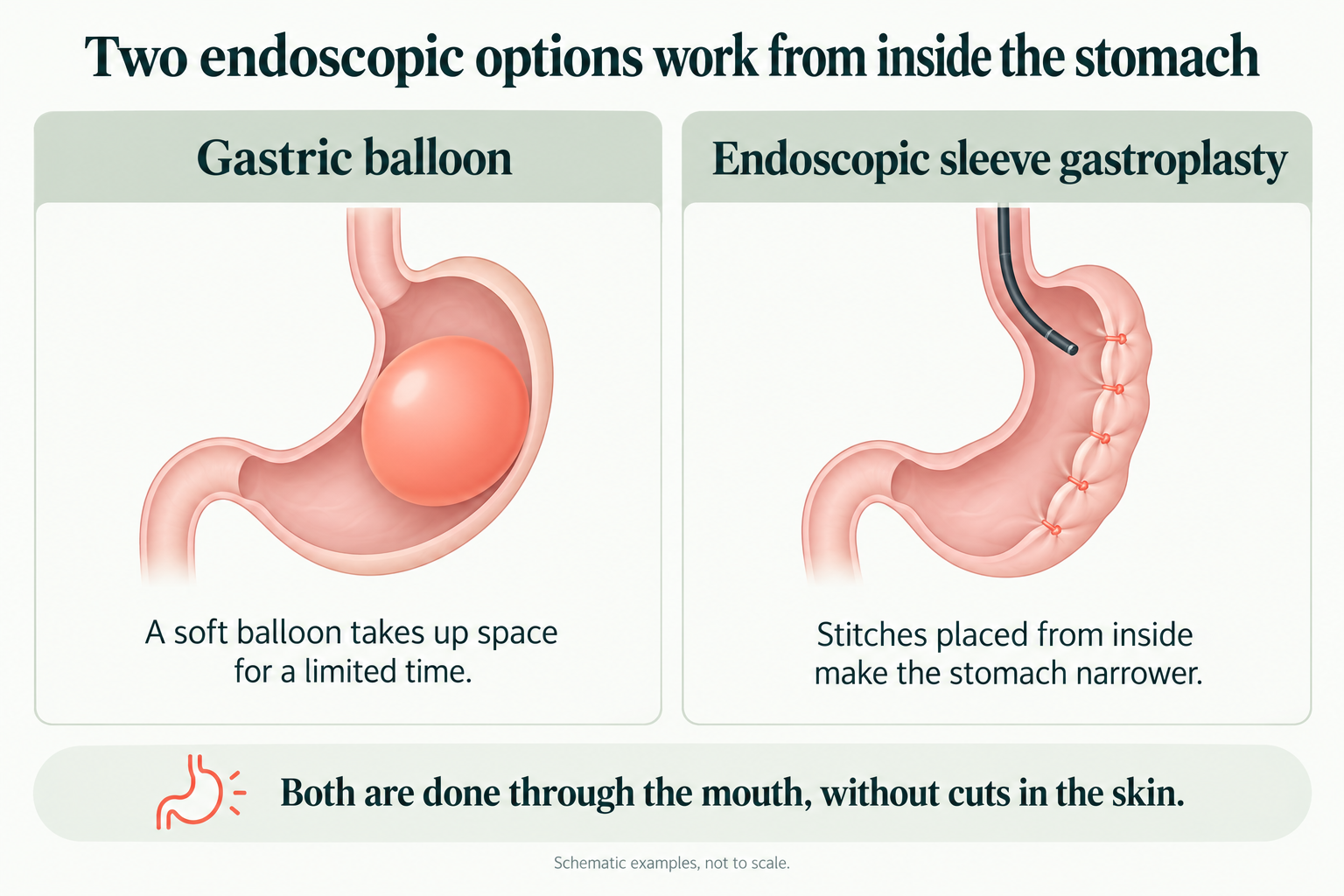
An intragastric balloon is a temporary device inside the stomach that takes up space and helps you feel full with less food.
Free Bookimed support. Compare options before deciding.
What they are
An intragastric balloon is a temporary device inside the stomach that takes up space and helps you feel full with less food. Endoscopic sleeve gastroplasty (ESG) folds and stitches the stomach from inside, using a flexible instrument passed through the mouth, without removing stomach tissue. They are different treatments: a balloon has a planned removal or exit, while ESG changes the stomach’s shape with stitches. [1][2]
Sources (2)
Who they are for — and who may not be suitable
The 2024 joint American and European endoscopy guideline suggests these treatments alongside changes to eating and activity for adults with a body mass index (BMI, a measure of weight relative to height) of at least 30. It also includes adults with BMI 27.0–29.9 who have at least 1 obesity-related health condition. These thresholds start a discussion; they do not establish that a particular balloon or ESG is suitable for you. [4]
The choice depends on previous weight-loss treatment, health conditions, stomach anatomy and the ability to continue follow-up. The 2026 international IFSO consensus supports assessment by a team with different specialties before ESG. Endoscopic treatment can be an option for someone seeking an alternative to surgery, but the decision also needs to account for the amount of weight loss needed and the reasons surgery is being avoided. [5][6]
A stomach ulcer or a hiatus hernia, where part of the stomach moves up through the diaphragm, may prevent balloon placement. These findings excluded patients in a randomized balloon trial. A separate balloon study excluded people who were pregnant, had previous bariatric surgery, severe heart, liver or kidney dysfunction, or certain digestive diseases. These trial exclusions are not a complete checklist for every device: they identify issues that need specialist review rather than automatic online booking. [7][8]
For ESG, suitability also requires an assessment of the stomach and the safety of anaesthesia. If a condition makes surgery unsuitable, that does not by itself establish that ESG is suitable. A specialist team needs to assess the person, not just the BMI, and agree on follow-up. [9][10]
Results to expect
The percentages below describe total body weight loss: the share of starting weight lost, not the share of “excess” weight. They are study averages, not a promised result. Balloon and ESG results come from different groups, so the figures are not a direct head-to-head comparison.
Gastric balloon: short-term loss and a maintenance plan
The 2024 joint endoscopy guideline pooled randomized trials in which balloons were used with lifestyle support. Average total weight loss was 10.7% at balloon removal, generally 6–8 months, compared with 3.4% in the control groups. At 12 months, the pooled result from 2 trials was 7.9% with balloon treatment versus 3.3% in controls. The later estimate draws on fewer trials, not the entire earlier group. [11]
A balloon is not a permanent treatment inside the stomach. Weight can return after removal, so the maintenance plan matters as much as placement. Longer-term care may involve continued dietary support and reassessment of obesity treatment. The short-term figures cannot be carried forward as a prediction of weight at 5 or 10 years. [12][13]
ESG: stronger evidence at a year than over a decade
A 2026 systematic review and meta-analysis — a study combining results from other studies — included 33 studies and 8,880 patients overall. It reported average total body weight loss of 17.88% at 1 year. Most included studies were observational, meaning treatment was not randomly assigned; the total review population is not the number measured at every follow-up point. [14]
The 2024 IFSO evidence review reported 15.9% total body weight loss at 5 years. That estimate came from just 1 study with 56 patients at that time point. It offers evidence that a benefit can last, but does not establish the same result for everyone or a reliable 10-year prediction. [15]
Diabetes and other health conditions
The 2026 ESG review reported remission in 62% of patients with type 2 diabetes, 43% with high blood pressure and 43% with abnormal blood fats in the relevant study groups. Remission means the condition met the study’s criteria for no longer being active; it is not a guarantee of permanent cure. Definitions and follow-up differ, so these percentages are not an individual chance of stopping medication. [16]
Effects on liver disease also need careful interpretation. A small randomized ESG trial in people with obesity and fatty-liver inflammation did not find a difference in liver scarring compared with the control treatment. Weight loss is a useful goal, but it is not a promise that established liver damage will reverse. [17]
Risks and side effects
Balloon: early intolerance is important
Pain, nausea and vomiting can make the early period difficult. In a 2025 randomized study comparing balloon filling volumes, pain occurred in 78.3%, nausea in 76.8% and vomiting in 50.7% of 156 patients. Ten needed early removal because of symptoms. This was a single-centre study, not a universal rate for every balloon, but it shows why early support and a removal plan matter. [18]
Serious complications include dehydration, stomach ulcers or bleeding, a tear through the digestive wall, and blockage of the stomach outlet or bowel. The 2024 joint guideline reported ulcer or bleeding in 5 of 650 balloon patients and perforation, meaning a hole through the wall, in 2 of 653. The denominators differ because not every trial reported each complication. [19]
No deaths occurred among the 741 balloon patients in trials reporting that outcome to the guideline. That is not a zero-risk guarantee: a Spanish consensus based on experience with 20,680 balloons reported a death. Placement and removal both need appropriate clinical facilities. [20][21]
ESG: less invasive does not mean risk-free
The 2024 IFSO review reported a serious adverse event rate of 1.25%, with 194 events among 15,398 ESG procedures. These are events meeting serious-event criteria, not every episode of pain or nausea. A separate 2025 practice guideline describes bleeding, perforation, an abnormal opening or tract called a fistula, and blockage among the possible complications. [22][23]
Reflux — stomach contents flowing back into the food pipe — is another consideration. The ESG practice guideline describes new reflux as less frequent after ESG than after surgical sleeve removal. This does not mean that existing reflux disappears or that ESG has no complications. The quoted overall serious-event rate cannot be used as a separate estimate of bleeding, leakage or death. [24][25]
For either treatment, the aftercare discussion needs to cover troublesome vomiting, inability to maintain fluid intake, and severe pain, including whom to contact locally and after returning home. Balloon complications can require rehydration or early removal; ESG complications may need another endoscopic procedure. A diet and nutrition plan is part of treatment, not an optional extra.
Recovery and life after treatment
Hospital time is not the same as travel clearance
NICE guidance describes ESG under general anaesthesia, meaning you are asleep during the procedure. It may be a day-case treatment, but most people are observed overnight and leave the next day. A package may allow a longer stay: the  KCM Clinic ESG offer lists 1 hospital day and 3 hotel days. Neither description guarantees that you will be ready to work, exercise or fly on a particular date. [31][32]
Balloon stays vary by device and package. KCM Clinic‘s Orbera offer lists 1 hospital day and 2 hotel days. The clinic needs to confirm discharge criteria and a travel plan that allows for early nausea, vomiting or poor fluid intake, rather than treating the advertised hotel stay as a medical recovery timetable. [33][34]
Eating, medicines and follow-up
Food is reintroduced in stages. For example, a 2025 balloon trial used liquids during the first week, followed by soft food and then a calorie-reduced solid diet, with dietitian support. This is a study protocol, not a diet prescription for every balloon or for ESG. The treating team needs to provide the plan for the actual procedure, including hydration, nutrition and follow-up. [35][36]
The joint endoscopy guideline supports acid-suppressing medication while a balloon is in place and short-term acid suppression after endoscopic stomach reshaping. The specific medicines and duration belong in the clinic’s discharge plan. Continuing follow-up is important: the ESG practice guideline identifies attendance at follow-up visits as a predictor of successful weight loss. [37][39]
Endoscopically placed balloons need a scheduled removal. Timing depends on the model: the comparative literature describes standard removal at 6 months and up to 12 months for systems such as Orbera365. Swallowable systems have a different pathway, so “gastric balloon” alone is not enough to identify the treatment being offered. Confirm the exact system, how it leaves the stomach, who provides urgent care, and whether removal is included in the price. [40]
ESG does not involve a planned balloon-removal visit. Follow-up still needs to address eating, weight maintenance and whether further treatment is needed. A sustainable plan includes care after the trip, not only the procedure abroad. [41][42][43]
How it compares with surgical sleeve treatment
The main procedural alternative is laparoscopic sleeve gastrectomy, often called gastric sleeve surgery, performed through small cuts in the abdomen. Unlike ESG, it removes part of the stomach rather than folding and stitching it internally. A 2025 practice guideline finds less weight loss with ESG in the short to medium term, but less new reflux than with surgical sleeve treatment. A balloon offers temporary treatment; ESG offers a stomach-preserving reshaping procedure. The choice depends on the desired weight loss, health conditions and willingness to accept the different risks and follow-up requirements. [44][45][47]
Cost and booking on Bookimed
Recorded public package prices, according to the clinics. The median is the middle listed price, not a personal quote. Different procedures and inclusions are not directly comparable. Dates refer to the source collection, not a guarantee of price validity. Confirm the exact procedure, operator, hospital, exclusions and follow-up in a current itemised offer.
Endoscopic treatments
USD 1459.37–8500.00; median 2850.00 (29 packages; recorded 2026-10-21) Packages and sources
Compare specialists · Compare clinics
Compare 29 packages, clinics and price sources
KCM Clinic · Poland · USD 3019.77–7846.90 · 4 packages
- Program Allurion — USD 3019.77 Price source · Recorded 2026-10-21 (collection date; validity not supplied)
- Orbera 365 Balloon at KCM Clinic 2750 Euro — USD 3087.12 Price source · Recorded 2026-10-21 (collection date; validity not supplied)
- ESG Surgery at KCM Clinic 2026 Package — USD 7734.64 Price source · Recorded 2026-10-21 (collection date; validity not supplied)
- ESG Surgery at KCM Clinic 2026 Package — USD 7846.9 Price source · Recorded 2026-10-21 (collection date; validity not supplied)
Centro Médico Teknon · Spain · USD 6735.54–7858.00 · 2 packages
- Gastric balloon, leading bariatrc surgeon Dr. Jose Vicente Ferrer Valls — USD 6735.54 Price source · Recorded 2026-10-21 (collection date; validity not supplied)
- Endoscopic Intragastric Balloon Placement for Weight Loss — USD 7858 Price source · Recorded 2026-10-21 (collection date; validity not supplied)
Hospital de la Familia · Mexico · USD 2600.00–2850.00 · 8 packages
- Gastric balloon — USD 2600 Price source · Recorded 2026-10-21 (collection date; validity not supplied)
- Gastric Ballon — USD 2750 Price source · Recorded 2026-10-21 (collection date; validity not supplied)
- Gastric Ballon — USD 2750 Price source · Recorded 2026-10-21 (collection date; validity not supplied)
- Gastric Ballon — USD 2750 Price source · Recorded 2026-10-21 (collection date; validity not supplied)
- Gastric Ballon — USD 2750 Price source · Recorded 2026-10-21 (collection date; validity not supplied)
- Gastric balloon — USD 2850 Price source · Recorded 2026-10-21 (collection date; validity not supplied)
- Gastric Ballon — USD 2850 Price source · Recorded 2026-10-21 (collection date; validity not supplied)
- Gastric Ballon — USD 2850 Price source · Recorded 2026-10-21 (collection date; validity not supplied)
Lokman Hekim Istanbul Hospital · Turkey · USD 1459.37–2806.47 · 7 packages
- Gastric balloon surgery package — USD 1459.37 Price source · Recorded 2026-10-21 (collection date; validity not supplied)
- Gastric Balloon Package — USD 1515.5 Price source · Recorded 2026-10-21 (collection date; validity not supplied)
- Gastric Balloon Package — USD 1683.88 Price source · Recorded 2026-10-21 (collection date; validity not supplied)
- Gastric Balloon Package- All Inclusive — USD 1683.88 Price source · Recorded 2026-10-21 (collection date; validity not supplied)
- Gastric Balloon Packages with 2 Options — USD 1796.14 Price source · Recorded 2026-10-21 (collection date; validity not supplied)
- Gastric Balloon Package — USD 2020.66 Price source · Recorded 2026-10-21 (collection date; validity not supplied)
- Gastric Balloon Package — USD 2806.47 Price source · Recorded 2026-10-21 (collection date; validity not supplied)
Memorial Ataşehir Hospital · Turkey · USD 3000.00–8500.00 · 7 packages
- Gastric Balloon — USD 3000 Price source · Recorded 2026-10-21 (collection date; validity not supplied)
- Allurion Balloon — USD 3367.77 Price source · Recorded 2026-10-21 (collection date; validity not supplied)
- Endoscopic Sleeve Gastronomy — USD 8400 Price source · Recorded 2026-10-21 (collection date; validity not supplied)
- Endoscopic Sleeve Gastroplasty (ESG) — USD 8500 Price source · Recorded 2026-10-21 (collection date; validity not supplied)
- Endoscopic Sleeve Gastroplasty (ESG) — USD 8500 Price source · Recorded 2026-10-21 (collection date; validity not supplied)
- Endoscopic Sleeve Gastroplasty (ESG) — USD 8500 Price source · Recorded 2026-10-21 (collection date; validity not supplied)
- Endoscopic Sleeve Gastroplasty (ESG) — USD 8500 Price source · Recorded 2026-10-21 (collection date; validity not supplied)
IRCCS OSPEDALE GALEAZZI – SANT’AMBROGIO · Italy · USD 5893.00–5893.00 · 1 packages
- Intragastric Balloon for Obesity — Consultation & ECG Included — USD 5893 Price source · Recorded 2026-10-21 (collection date; validity not supplied)
These are displayed package prices, not a personal treatment quotation. Confirm which procedure is covered and ask for an itemised explanation of the device or suturing procedure, anaesthesia, tests, hospital and hotel arrangements, removal where applicable, dietitian support and care for complications. Package names alone do not establish that all of these are included.
Browse the endoscopic procedure specialist catalogue and clinic catalogue. This section also has additional specialist information, another specialist profile and a further specialist profile. Confirm the clinician who will actually perform the proposed procedure and provide follow-up before choosing a package. [89]
Sources (29)
- Public package source
- Public package source
- Public package source
- Public package source
- Public package source
- Public package source
- Public package source
- Public package source
- Public package source
- Public package source
- Public package source
- Public package source
- Public package source
- Public package source
- Public package source
- Public package source
- Public package source
- Public package source
- Public package source
- Public package source
- Public package source
- Public package source
- Public package source
- Public package source
- Public package source
- Public package source
- Public package source
- Public package source
- Public package source
Next step
Use the Bookimed inquiry page to request a balloon-versus-ESG assessment and a procedure-specific package. The useful starting information is your height and weight, relevant health conditions, previous weight-loss treatment, medicines, prior stomach operations and preferred destination. Ask for a written plan covering eligibility, expected weight loss, risks, the stay abroad and follow-up at home, including balloon removal if relevant.
If you are still comparing treatment types, return to the bariatric surgery overview. A consultation is the next decision point, not a commitment to undergo a procedure.
Request a treatment proposal
Turn information into your next step.
Free Bookimed support. Compare options before deciding.
Free Bookimed support. Compare options before deciding.