Revisional bariatric surgery: redo or conversion after weight-loss surgery · Decision guide
Revisional bariatric surgery: redo or conversion after weight-loss surgery
Revisional bariatric surgery changes a previous weight-loss operation to address weight regain, an inadequate response or a complication such as persistent reflux.
Free Bookimed support. Compare options before deciding.
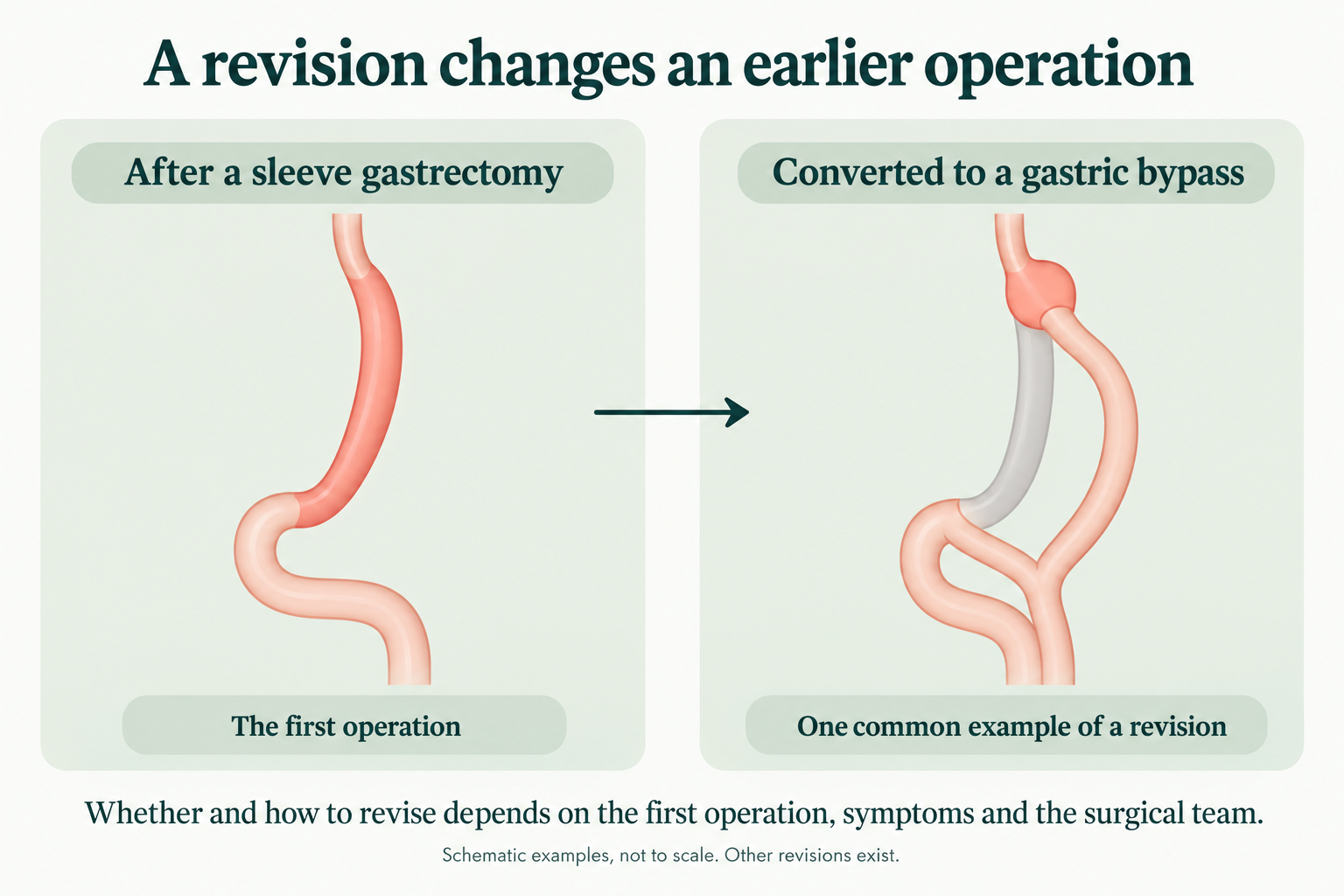
Revisional bariatric surgery changes a previous weight-loss operation to address weight regain, an inadequate response or a complication such as persistent reflux. A redo changes the existing operation; a conversion changes it into a different operation, such as turning a sleeve stomach into a gastric bypass. The right choice depends on the previous surgery and the problem being treated, not just the amount of weight a person hopes to lose. [1][2]
Who it is for — and when another approach may fit better
A revision may be considered when weight returns, weight loss has been insufficient, or obesity-related health problems persist. Reflux means stomach contents flowing back into the food pipe; severe reflux after a sleeve can justify discussing conversion even when weight loss has been adequate. A 2025 international expert consensus supports Roux-en-Y gastric bypass for that situation. This operation makes a small stomach pouch and reroutes food through the small bowel. [3][4]
Weight regain is not proof that someone has failed. A 2024 International Federation for the Surgery of Obesity position statement describes obesity as a chronic disease that may need further treatment over time. The assessment is therefore about what is driving the current problem and which treatment offers a reasonable balance of benefit and harm. [5][6]
Body mass index, or BMI, is a measure of weight relative to height. There is no single BMI cut-off offered here as an automatic qualification for revision: treating a complication and seeking more weight loss are different decisions. An international revisional-surgery consensus recommends an individualized assessment by a team, rather than deciding from weight alone. [7][8]
That assessment includes nutrition and psychological evaluation, endoscopy — a camera examination of the stomach — and contrast imaging, which shows the route food takes after the earlier operation. These help the team assess the altered anatomy, symptoms and ability to manage aftercare. The surgical, medical and nutrition teams need to agree on the goal before selecting the procedure. [9]
A further weight-loss operation is not automatically the next step for everyone with weight regain. Medication, dietary support or treatment through a flexible camera passed through the mouth may be alternatives. Someone with severe reflux after a sleeve is not interchangeable with someone seeking more weight loss without reflux; an operation chosen mainly for weight loss may not suit the reflux problem. This page cannot establish fitness for anesthesia or give an individual surgical clearance. [10][11]
Results to expect
The most useful prediction is for the exact conversion being proposed. Results after a sleeve-to-bypass conversion cannot simply be applied to a revision of an existing bypass or removal of a gastric band. Total weight loss means the percentage of body weight lost from the starting point used for the revision assessment, rather than the percentage of weight above a target weight. The latter is called excess weight loss, and the measures are not interchangeable.
Weight loss over time
One option after a sleeve or gastric band is SADI-S: a sleeve stomach combined with a connection from the beginning of the small bowel to a more distant part, so food bypasses much of the bowel. A 2026 meta-analysis, which pooled results from 18 articles with 1,641 revisional cases, reported average total weight loss of 23.78% at 1 year and 22.11% at 5 years. These are procedure-specific averages, not a promise for every redo operation. The longer-term estimate does not mean that every participant was followed for the full period. [12]
For conversion from a sleeve to gastric bypass, a 2022 randomized trial compared Roux-en-Y with one-anastomosis gastric bypass, which uses a single stomach-to-bowel connection. Among 160 patients analyzed, it found no clear weight-loss difference between the procedures at 1 or 2 years. People with more severe reflux-related inflammation of the food pipe were excluded, so the findings do not settle the choice for that group. [13]
A dependable ten-year weight-loss forecast for a particular revision cannot be given from this evidence. Long-term results from first-time bariatric operations are not a substitute. For a personal estimate, useful questions are how much additional weight loss is expected after this exact conversion and how many similar patients the team has followed over time.
Diabetes, blood pressure and reflux
In the SADI-S review, reported remission rates were 69% for diabetes, 41% for high blood pressure and 69% for obstructive sleep apnea, a condition in which breathing repeatedly stops during sleep. Remission means the condition met the study’s criteria for no longer being active; it is not a guarantee of permanent cure. These figures concern patients with the relevant condition, with differing follow-up periods, rather than everyone in the review or a uniform five-year outcome. [14]
Reflux may improve after conversion, but relief is not certain. A 2026 meta-analysis of sleeve-to-bypass conversions reported reflux resolution in 80.6% of the Roux-en-Y subgroup and 68.6% of the one-anastomosis subgroup. Follow-up ranged from 12 to 60 months. The difference was not statistically clear, and results varied substantially between studies; these percentages do not establish that the procedures are equally suitable for severe reflux. [15]
Risks and side effects — alongside the potential benefits
Early complications
A leak means digestive fluid escaping from a surgical join or staple line. In a 2025 meta-analysis of conversion from sleeve to bypass, leaks were reported in 9 of 366 Roux-en-Y patients, reported as 2.4%, and 7 of 373 one-anastomosis patients, reported as 1.8%. The review did not find a clear difference between the procedures. These figures describe those conversions, not every form of revisional surgery. [16]
The same review reported bleeding requiring treatment in 1% after Roux-en-Y and 1.9% after one-anastomosis conversion, without a statistically clear difference. These are study averages; the risk for a particular patient depends on the planned operation and their health. They are not a reason to choose a procedure on bleeding risk alone. [17]
Death is a serious possible surgical outcome. The sleeve-to-bypass randomized trial detected no deaths among the 160 patients analyzed, but that small study cannot establish a reliable death rate or prove that the risk is absent. A consultation needs to address the proposed center’s experience with this exact revision and the individual’s risk. [18]
Later problems and further treatment
SADI-S has its own trade-offs. Its 2026 review reported leaks in 2.9%, nutritional deficiencies in 4.2%, anemia in 5.7% and diarrhea in 8.7%. Anemia means too little hemoglobin, the blood component that carries oxygen. The review combined different follow-up periods and did not provide a common time window for these complications, so the percentages are not a single early-complication rate. They also cannot be directly compared with the bypass figures above as if the patients were the same. [19]
Reflux can persist or develop after conversion, and bypass can lead to ulcers at the new join. An internal hernia occurs when bowel moves through an internal opening; the resulting problem may need another operation. The sleeve-to-bypass trial reported hernias requiring further intervention and ulcers during follow-up. Having a revision does not remove the possibility of needing further treatment later. [20][21]
Recovery and life after revision
Hospital stay, work and travel
Hospital discharge, return to work and readiness to fly are separate decisions. There is no dependable timetable here that covers all revisions. A conversion for weight regain and an operation to correct a complication may have different recovery needs. The treating team can set expectations for hospital stay, local recovery near the hospital, lifting, driving, work and the flight home once the operation and medical assessment are agreed.
For treatment abroad, useful questions include who reviews symptoms after discharge, where urgent care is available, and how follow-up continues at home. A discharge plan needs to distinguish ordinary recovery symptoms from those requiring prompt assessment, rather than treating the end of the hospital stay as the end of care.
Food, supplements and follow-up
Nutrition care is part of treatment, not an optional extra. The revisional bypass trial included dietitian assessment before surgery and prescribed multivitamins, calcium and iron afterwards. It also checked nutritional blood results during follow-up. The diet and supplement plan needs to match the new anatomy and existing deficiencies; this guide does not supply a universal supplement dose or a fixed schedule for moving from liquids to solid food. [23]
Ongoing monitoring matters because a revision changes an already altered digestive system. Nutritional deficiencies, diarrhea or reflux may require treatment, and weight can recur. Follow-up offers a way to address these problems rather than judging the operation only by early weight loss. [26][27]
Persistent abdominal pain, fever, repeated vomiting, a rapid heartbeat or a swollen abdomen were warning signs that prompted investigation for complications in the revisional bypass trial. These symptoms are reasons for prompt medical assessment, not simply waiting for a routine weight-loss review. [28]
How it compares with treatment without another operation
For weight regain without a complication requiring surgery, the main alternative is specialist-led medical treatment, including obesity medication and nutrition support. An American Society for Metabolic and Bariatric Surgery statement also describes endoscopic treatment: for example, tightening an enlarged bypass outlet through a flexible camera rather than performing another abdominal operation. It characterizes endoscopic weight loss as modest but meaningful, with low complication rates. These options and surgery address different needs, so an individualized assessment is more useful than declaring a universal winner. [29]
Cost and booking on Bookimed
Recorded public package prices, according to the clinics. The median is the middle listed price, not a personal quote. Different procedures and inclusions are not directly comparable. Dates refer to the source collection, not a guarantee of price validity. Confirm the exact procedure, operator, hospital, exclusions and follow-up in a current itemised offer.
Revision
No public price recorded. Request an individual estimate.
A linked profile alone does not confirm that the surgeon offers the exact revision required; the clinical decision needs the individualized team assessment described above.
Questions for an itemized offer include whether it covers the assessment, tests, surgeon and anesthesia fees, hospital care, medicines, nutritional follow-up and treatment of complications. Travel, accommodation and a longer stay near the hospital also need clarification. No total cost or included service is promised here.
Next step
Use the inquiry page to request an assessment for the specific problem: weight regain, limited weight loss, reflux or another complication. Helpful information for the conversation includes the previous operation and date, the weight changes since then, current symptoms and existing test results. The aim is to establish whether another operation is appropriate, which conversion addresses the problem, and what care and costs the proposed offer actually covers — before committing to travel.
Turn information into your next step.
Free Bookimed support. Compare options before deciding.
Free Bookimed support. Compare options before deciding.