Robotic bariatric surgery: robotic sleeve and gastric bypass · Decision guide
Robotic bariatric surgery: robotic sleeve and gastric bypass
Robotic bariatric surgery is weight-loss surgery performed through small cuts, with the surgeon controlling robotic instruments rather than the robot operating independently.
Free Bookimed support. Compare options before deciding.
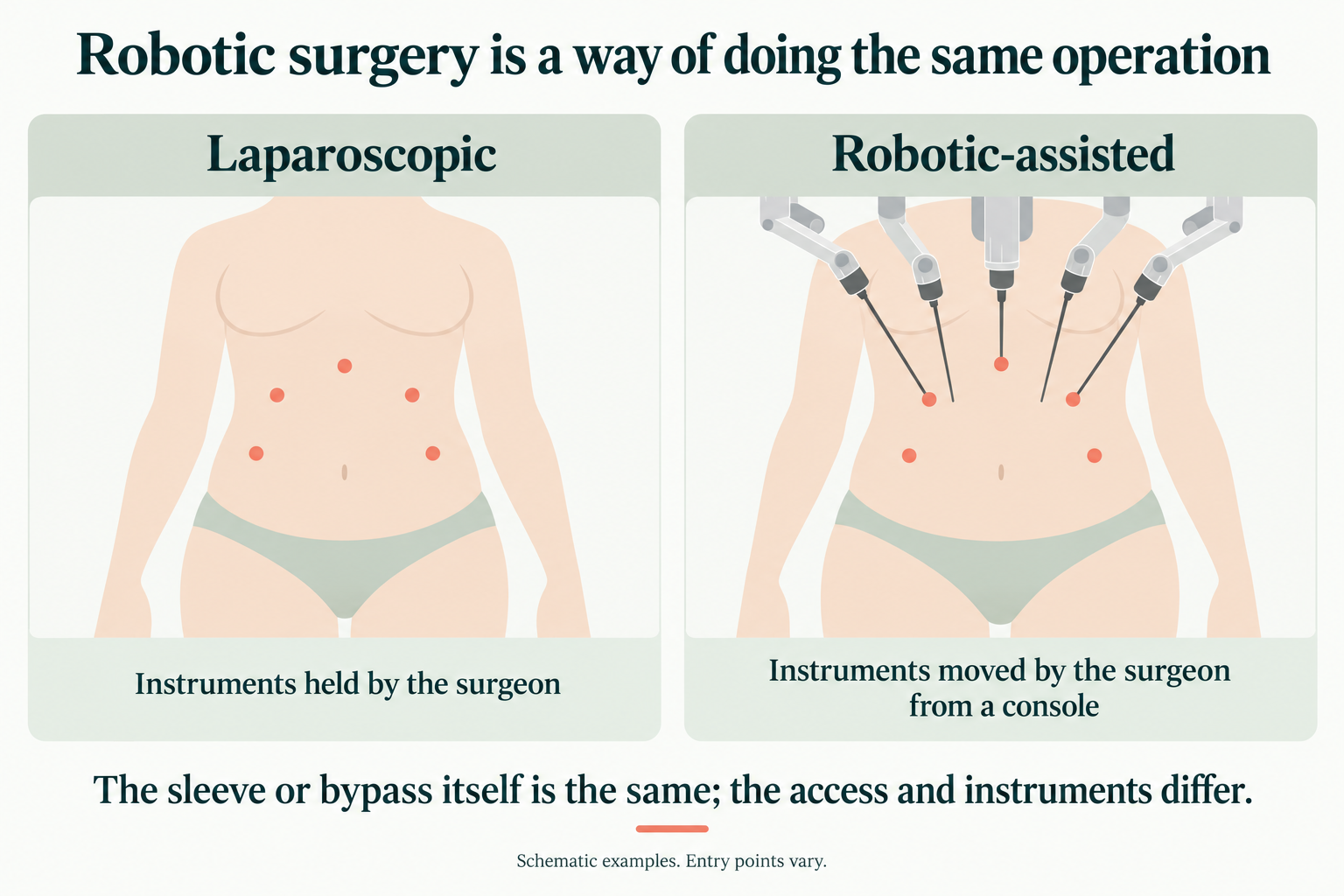
Robotic bariatric surgery is weight-loss surgery performed through small cuts, with the surgeon controlling robotic instruments rather than the robot operating independently. A sleeve gastrectomy removes much of the stomach to leave a narrow stomach tube; a gastric bypass makes a small stomach pouch and redirects food through part of the small bowel. The robot is a way of carrying out the operation, not a different weight-loss treatment: choosing between sleeve and bypass matters separately from choosing the surgical equipment.
Who is robotic bariatric surgery for?
Eligibility starts with whether bariatric surgery is appropriate, not whether a robot is available. BMI, or body mass index, relates weight to height. The 2022 international guideline from the American Society for Metabolic and Bariatric Surgery and the International Federation for the Surgery of Obesity and Metabolic Disorders recommends surgery at BMI 35 or above, even without another obesity-related illness. It also supports considering surgery at BMI 30–34.9 with metabolic disease, such as diabetes, which affects blood-sugar control. [1]
For adults in the lower BMI range, the guideline supports considering surgery when nonsurgical treatment has not produced lasting weight loss or adequate improvement in associated illness. It also uses a lower threshold for Asian populations, recommending that surgery be offered from BMI 27.5. These are assessment criteria, not automatic approval for an operation or a particular robotic technique. [2]
Who may need to postpone surgery or choose another approach?
The guideline calls for medical, surgical, nutritional and mental-health assessment. Severe uncontrolled mental illness, active substance misuse and disordered eating need to be addressed during preparation. They are reasons for further assessment and treatment, rather than a reason to assume that anyone with a mental-health diagnosis can never have surgery. Nutritional deficiencies also need correction before the operation. [4]
A robot does not remove the need for this preparation. A consultation needs to establish whether sleeve or bypass fits the person’s medical needs, and whether the operating team has relevant experience. Evidence about robotic bypass has inconsistently described patient selection and surgeon experience, so the equipment name alone is not a reliable guide to the likely result. [6]
Results to expect
Weight loss: separate the operation from the robot
For robotic sleeve, a 2024 systematic review combining results from 21 articles found similar weight loss to conventional laparoscopic sleeve. Laparoscopic surgery is also keyhole surgery, but the surgeon handles the instruments directly. A newer 2026 review of prospective comparative studies found a small advantage in BMI at 12 months with the robot, but rated the evidence very low certainty. That is not enough to promise better weight loss from choosing a robot. [7][8]
For robotic Roux-en-Y gastric bypass, the bypass design considered in the main comparative reviews, a 2025 meta-analysis reported average excess weight loss of 68.3% at 1 year, compared with 67.1% after laparoscopic bypass. The difference was not statistically significant. Excess weight loss means the share of weight above a reference healthy weight that is lost; it does not mean losing that share of total starting body weight. These pooled averages are not a personal target. [10]
At 5 and 10 years, the international guideline supports lasting weight loss after bariatric surgery overall. It does not establish a separate long-term weight-loss forecast for robotic sleeve or robotic bypass. The useful question for a consultation is the expected result of the proposed operation in people with a similar starting weight and medical history—not an extra benefit attributed to the robot. [11][12]
Diabetes and other health conditions
The same 2025 bypass meta-analysis reported diabetes remission at 5 years in 68.2% of the robotic group and 65.7% of the laparoscopic group, without a statistically significant difference. Remission means diabetes improves enough to meet the study’s remission criteria; it is not a guarantee of permanent cure. The summary does not specify the number of patients contributing to this particular outcome or the exact remission criteria, so these figures are a broad comparison, not a personal chance of stopping medication. [13]
The international guideline also describes improvement in obesity-related conditions, including high blood pressure, sleep apnea—repeated pauses in breathing during sleep—and fatty liver disease. These are benefits of bariatric treatment and weight loss; they do not establish an added benefit from robotic assistance. [14]
Risks and side effects to weigh alongside the results
Early problems
Leaks, where fluid escapes from a stomach staple line or bowel join, and bleeding remain possible after robotic surgery. A 2026 systematic review of robotic versus laparoscopic sleeve did not find a clear difference in either complication. Its evidence was very uncertain, so a failure to detect a difference does not prove that the risks are identical. [15]
For bypass, the 2025 meta-analysis reported death within 30 days in 0.06% of robotic patients and 0.11% of laparoscopic patients. Major complications occurred in 4.2% and 4.5%, respectively. Neither difference was statistically significant. These are pooled bypass-study figures, not robotic sleeve rates or the results of the Bookimed surgeon listed below. [16]
Another systematic review, published in 2024 and including 82,155 patients, found more repeat operations within 30 days after robotic bypass: 4.4%, compared with 3.4% after laparoscopic bypass. It did not find a difference in leaks, death or overall complications. Reviews include different patient groups and methods; taken together, they do not support a claim that robotic bypass is consistently safer. [17]
Later problems and further treatment
Reflux, where stomach contents come back up toward the throat, deserves discussion when choosing an operation. The international guideline identifies reflux, weight regain and insufficient weight loss as possible reasons for further bariatric surgery. Robotic assistance is not a reason to leave these long-term issues out of the decision. [19]
After Roux-en-Y bypass, bowel can slip through an internal gap and become trapped. This is an internal hernia, and it can cause bowel blockage. A 2025 Cochrane review found that closing these gaps during surgery may reduce the risk, although confidence in the evidence was low. The included trials used laparoscopic surgery, so the finding concerns bypass technique rather than a proven advantage of the robot. [20]
Both sleeve and bypass require attention to nutrition. Food intolerance and shortages of vitamins or minerals can occur after bariatric surgery, and follow-up is part of treatment rather than an optional extra. A British specialist-society guideline recommends lifelong nutritional monitoring. [21][22]
Recovery and life after surgery
The Bookimed robotic sleeve package lists 3 days in hospital and 3 days in a hotel. The robotic bypass package lists 4 days in hospital. These are package stay descriptions, not a promise of discharge on a fixed day or permission to fly immediately afterward; the bypass listing does not give a hotel stay. [23][24]
The available comparative reviews do not support promising a faster recovery just because a robot is used. Before booking travel, the clinic needs to confirm the planned local stay, discharge arrangements, travel clearance and who handles a complication after return home. Return to desk work, physical work and exercise needs an individual plan; the package’s hospital stay is not a return-to-work timetable. [25][26]
A bariatric dietitian helps prepare for the change in eating and manages food tolerance, nutritional shortages and weight regain afterward. The practical follow-up discussion includes the clinic’s staged eating plan, fluid and protein goals, prescribed vitamin and mineral supplements, and arrangements for blood tests at home. A generic robotic package cannot replace an operation-specific nutrition plan. [27][28]
The 2020 British nutrition guideline recommends lifelong monitoring, at least annually after discharge from specialist follow-up. That ongoing care needs to be included in the decision to travel for surgery, not left until after the trip. [29]
Persistent vomiting or difficulty swallowing is not an expected adjustment to simply put up with. The same guideline calls for investigation and referral back to the bariatric centre. Prolonged vomiting can also create serious nutritional problems, making access to medical review important. [30]
How does it compare with standard keyhole surgery?
The main alternative is the same sleeve or bypass operation performed laparoscopically, without a robot. Reviews generally find similar weight-loss and safety outcomes, while robotic sleeve often takes longer to perform; a small apparent weight-loss advantage in the newest sleeve review remains very uncertain. For bypass, the evidence includes a higher early repeat-operation rate in one large review. A useful comparison is the proposed operation, the surgeon’s relevant experience, their own outcomes, the full price and the follow-up plan—not an assumption that newer equipment is better.
Cost and booking on Bookimed
Recorded public package prices, according to the clinics. The median is the middle listed price, not a personal quote. Different procedures and inclusions are not directly comparable. Dates refer to the source collection, not a guarantee of price validity. Confirm the exact procedure, operator, hospital, exclusions and follow-up in a current itemised offer.
Robot-assisted surgery
USD 6406.00–29782.00; median 20283.00 (4 packages; recorded 2026-10-21) Packages and sources
Compare specialists · Compare clinics
Compare 4 packages, clinics and price sources
Anadolu Medical Center · Turkey · USD 6406.00–11379.00 · 2 packages
- Da Vinci Gastric Bypass Surgery at JCI-Accredited Hospital — USD 11379 Price source · Recorded 2026-10-21 (collection date; validity not supplied)
- Da Vinci Gastric Sleeve Surgery — Individual Chamber & Transfer Included — USD 6406 Price source · Recorded 2026-10-21 (collection date; validity not supplied)
IRCCS OSPEDALE GALEAZZI – SANT’AMBROGIO · Italy · USD 29187.00–29782.00 · 2 packages
- Robotic Da Vinci Sleeve Gastrectomy by IFSO Member with 9,000+ Operations — Translation Included — USD 29187 Price source · Recorded 2026-10-21 (collection date; validity not supplied)
- Robotic Da Vinci Gastric Bypass by IFSO Member with 9,000+ Operations — Translation Included — USD 29782 Price source · Recorded 2026-10-21 (collection date; validity not supplied)
For the robotic Da Vinci gastric bypass package with Alessandro Giovanelli: The package title does not identify the bypass configuration: the clinic needs to confirm whether the proposed operation is Roux-en-Y before applying the Roux-en-Y research above to that offer.
The listed programme prices and stay descriptions do not establish an all-inclusive travel budget: a written offer needs to clarify accommodation charges, tests, medicines, supplements, follow-up, extra nights and treatment of complications.
Next step
Use the Bookimed inquiry page to request an assessment and an itemised offer. Useful details for the clinical discussion include height and weight, diabetes treatment, reflux symptoms, previous abdominal or weight-loss surgery, current medicines and the plan for follow-up at home. The key questions are: which operation fits my health needs, why use a robot in my case, what outcomes does this team achieve, and who will provide care after I return home?
Request a treatment proposal
Robotic Roux-en-Y gastric bypass
Robotic Assisted Mini Gastric Bypass
Turn information into your next step.
Free Bookimed support. Compare options before deciding.
Free Bookimed support. Compare options before deciding.