Adjustable gastric banding: results, risks and treatment abroad · Decision guide
Adjustable gastric banding: results, risks and treatment abroad
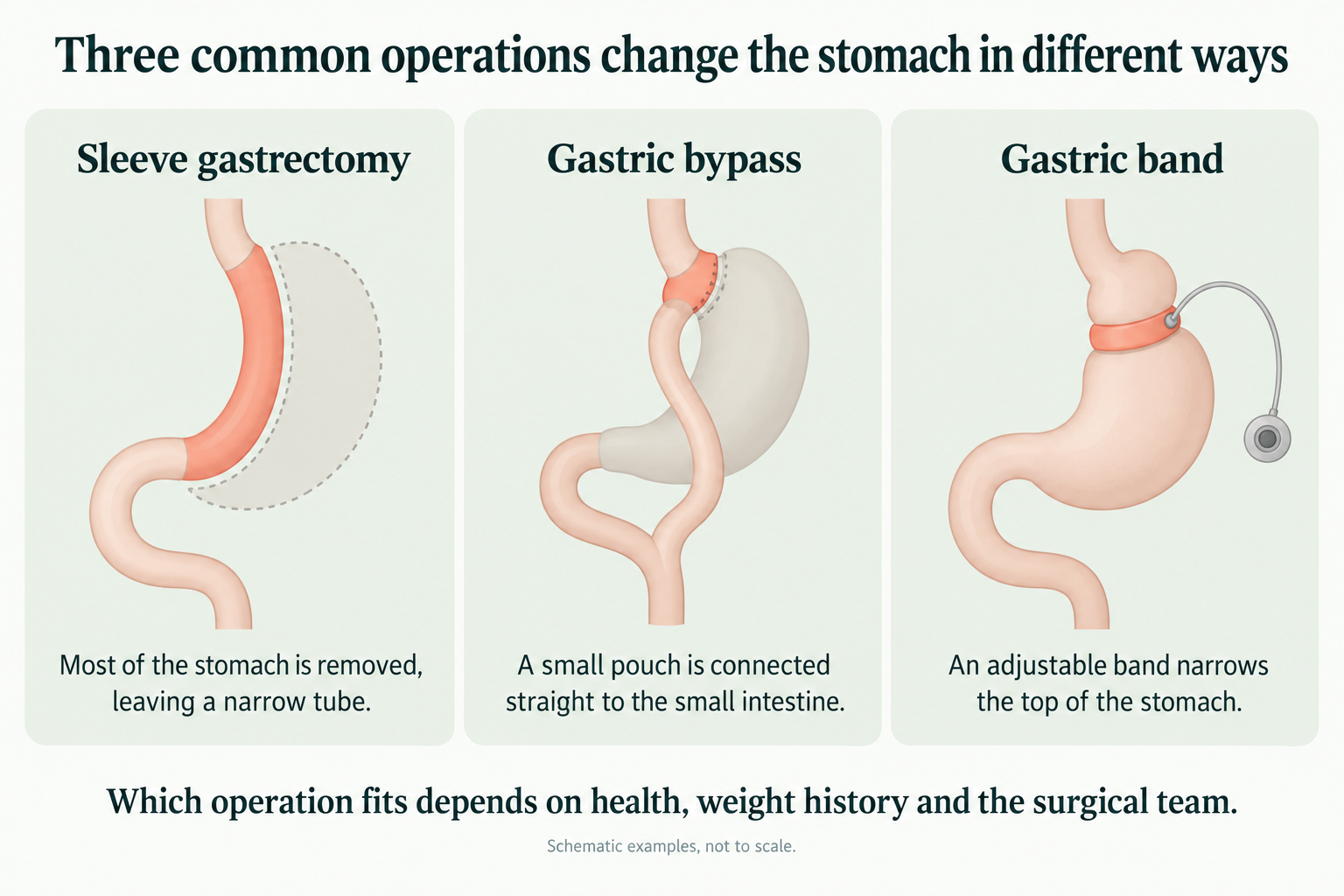
Adjustable gastric banding places a silicone band around the upper stomach to create a small pouch and help you feel full with less food.
Free Bookimed support. Compare options before deciding.
What it is
Adjustable gastric banding places a silicone band around the upper stomach to create a small pouch and help you feel full with less food. It is performed through small cuts, using a camera, and the band can be tightened or loosened through an access port under the skin without another operation. The band can also be removed, but that requires a further procedure; “removable” does not mean free of long-term problems. [1][2]
Who it is for — and who should not have it
Banding may appeal to an adult who wants an adjustable operation and can attend ongoing visits for band care. However, qualifying for weight-loss surgery does not automatically make a band the right choice. A European guideline based on a systematic review of randomised trials suggests sleeve gastrectomy or gastric bypass over banding for severe obesity and related metabolic disease. [3][4][5]
BMI, or body mass index, relates weight to height. The body of the 2022 international ASMBS/IFSO guideline strongly recommends bariatric surgery at a BMI of 35 or above, whether or not an obesity-related condition has been diagnosed. It also supports considering surgery at a BMI of 30–34.9 when nonsurgical treatment has not produced substantial, lasting weight loss or improvement in related conditions. These are criteria for assessing surgery generally, not a promise of eligibility for a gastric band. [6]
Surgery is not a booking decision based on weight alone. The same international guideline calls for assessment of eating patterns, mental health and the ability to manage life after surgery. Severe uncontrolled mental illness, active substance abuse and disordered eating need assessment and treatment planning before proceeding. A history of depression or an eating disorder is not, by itself, a blanket exclusion. The surgeon and wider care team assess readiness. [8]
For someone travelling abroad, access to band care at home is central to the decision. A short overseas stay cannot replace ongoing adjustments and assessment. Existing swallowing difficulties, reflux or food intolerance also deserve discussion before choosing this operation, because these symptoms can be part of later band problems. [9]
Sources (4)
- Carlos Ballesta Lopez
- What is known about long-term weight loss?
- Is banding the usual preferred operation?
- 2022 American Society of Metabolic and Bariatric Surgery (ASMBS) and International Federation for the Surgery of Obesity and Metabolic Disorders (IFSO) Indications for Metabolic and Bariatric Surgery.
Results to expect
Weight loss
The 2025 By-Band-Sleeve randomised trial provides a useful comparison in adults with severe obesity. At 3 years after assignment to treatment, average loss of starting body weight was 14.0% in the band group, compared with 19.4% after assignment to sleeve and 26.8% after assignment to bypass. These are group averages, not a personal forecast. The clock started at treatment assignment, and some participants waited for surgery or did not undergo it. [12]
The same trial used another measure: “excess weight loss,” meaning weight lost as a share of the weight above a reference healthy weight. At 3 years, 97 of 383 assessed participants assigned to banding, or 25%, had lost at least half of their excess weight. The corresponding proportions were 41% for sleeve and 68% for bypass. Losing half of excess weight is not the same as losing half of starting body weight. [13]
Long-term results need a different interpretation. A 2022 American society consensus statement summarises reports of about 47% excess weight loss at 10–20 years after banding. This is not 47% of starting weight, and it is not a precise prediction for the tenth year. A 2026 network meta-analysis of randomised trials with at least 10 years of follow-up did not establish a statistically clear advantage for banding over medical treatment in total weight loss. That does not prove the treatments are equivalent: the populations, methods and uncertainty differ from the long-term reports summarised in the consensus statement. [14][15]
There is no single reliable timetable that applies to every patient. Band adjustment, eating tolerance and continued follow-up influence the result. A clinic consultation can set individual milestones rather than treating a study average as a target that everyone will reach. [16]
Diabetes and other health conditions
A review combining randomised trials found that banding can improve type 2 diabetes outcomes compared with medical or lifestyle treatment. Remission means blood sugar meets a study’s target without diabetes medication; it is not a guaranteed permanent cure, and study definitions differ. A Cochrane review judged the evidence for complete long-term diabetes remission across the operations very uncertain. Medication changes remain part of clinical follow-up, not an automatic consequence of having a band. [17][18]
Sleep apnoea means repeated interruptions to breathing during sleep. A systematic review found that it resolved more often after sleeve surgery than after banding in the studies comparing those operations. Banding therefore cannot be assumed to offer the same benefit for this condition as another weight-loss operation. [19]
Risks and side effects
The possibility of another operation belongs beside the weight-loss results. In the By-Band-Sleeve randomised trial, 52 of 363 people who received a band, or 14%, needed an operation to correct it, remove it or convert to another weight-loss procedure during follow-up through 3 years after treatment assignment. That figure does not describe lifetime risk. [20]
Early risks
A band does not make surgery risk-free. In the same trial, 1 patient in the band group died during the surgical admission after a leak from stomach sutures caused infection inside the abdomen and sepsis, a dangerous whole-body response to infection. Overall adverse-event rates during the first 30 days were similar across the operations. This single trial event is not a stable estimate of an individual’s risk of death. Bleeding risk and the clinic’s own early complication rates are important topics for the surgical consent discussion. [21]
Later problems
The American society’s band-management consensus describes several possible problems. Slippage means part of the stomach moves up through the band. Erosion means the band wears through the stomach wall. Reflux is stomach contents flowing back into the food pipe, causing symptoms such as heartburn or regurgitation. The food pipe can also widen, and the port or tubing can leak or become infected. A device leak is different from a leak of stomach contents. [22]
Treatment depends on the cause. It may involve loosening the band, dietary support, replacing a component or removing the band. Some people need conversion to another operation. Difficulty eating is not evidence that a band is working well: persistent vomiting, regurgitation or trouble swallowing can call for fluid removal by a trained clinician and review by a bariatric surgeon. [23]
New severe upper abdominal pain or inability to keep liquids down needs urgent medical assessment. The band-management consensus describes these symptoms with slipped bands and potentially serious stomach complications. Waiting for a routine overseas follow-up appointment is not appropriate for these symptoms. [25]
Nutritional problems are still possible. The consensus recommends a daily multivitamin and mineral supplement, with additional supplements guided by blood tests. Persistent vomiting also calls for assessment for thiamine deficiency — a shortage of an essential vitamin — and disturbances in the body’s fluid and mineral balance. [26]
Recovery and life after banding
The Bookimed package in Barcelona describes 1–2 days in hospital and a total local stay of 10 days, including follow-up. The hospital duration needs confirmation with the clinic before travel. This is a package itinerary, not a general recovery guarantee or clearance to fly. Return to work, exercise and travel depends on the surgical team’s assessment and the demands of your normal activities. [27]
Eating after banding involves a supervised return to tolerated foods, attention to nutritional quality and ongoing support. The band-management consensus describes slow eating and thorough chewing. Large pills can cause problems; a clinician or pharmacist can review suitable formulations rather than assuming every medicine can be crushed. Vomiting or difficulty swallowing calls for review rather than simply accepting a more restricted diet. [28]
The 2022 band-management consensus describes starting adjustments around 4–6 weeks after surgery, once regular food is tolerated, with reassessment every 4–6 weeks until the intended rate of weight loss is reached. It also calls for assessment at least yearly, and more often during active adjustments or complications. The first adjustment date therefore needs an individual plan; it is not guaranteed to fall within the overseas package stay. [31]
The practical question is not only where to have surgery, but who will care for the band afterwards. A named local service, a way to contact the operating team and a plan for symptoms or poor weight loss make the follow-up arrangements clear. The listed package offers remote follow-up recommendations, which are not the same as hands-on access to port adjustments at home. [33][35]
How it compares with the main alternatives
Sleeve gastrectomy reduces the size of the stomach, while gastric bypass creates a small stomach pouch and redirects the route food takes through the intestine. Unlike a removable band, these operations change the digestive anatomy more substantially. Yet adjustability alone does not make banding preferable: the European guideline favours sleeve or bypass over a band, and the large randomised trial found greater average weight loss with both alternatives. The decision balances expected benefit, eating symptoms, medical conditions and willingness to manage a device long term. [36][37][38]
Cost and booking on Bookimed
Recorded public package prices, according to the clinics. The median is the middle listed price, not a personal quote. Different procedures and inclusions are not directly comparable. Dates refer to the source collection, not a guarantee of price validity. Confirm the exact procedure, operator, hospital, exclusions and follow-up in a current itemised offer.
Band
USD 10103.31–17983.00; median 14043.16 (2 packages; recorded 2026-10-21) Packages and sources
Compare specialists · Compare clinics
Compare 2 packages, clinics and price sources
Centro Médico Teknon · Spain · USD 10103.31–17983.00 · 2 packages
- Laparoscopic Gastric Banding — 10-Day Follow-Up Included — USD 17983 Price source · Recorded 2026-10-21 (collection date; validity not supplied)
- Gastric band, leading specialist Dr.Jose Vicente Ferrer Valls. — USD 10103.31 Price source · Recorded 2026-10-21 (collection date; validity not supplied)
A personalised plan can confirm the final scope and availability.
For the Carlos Ballesta Lopez package at Centro Médico Teknon: The package description lists preoperative consultations and tests, laparoscopic band placement, the adjustable band and access port, general anaesthesia, a private hospital room, recovery monitoring, nutritional counselling and a 10-day postoperative follow-up programme. It mentions a first adjustment only if required and remote follow-up recommendations after returning home. Transfer is excluded. [40]
Before comparing total travel costs, the details to clarify are accommodation outside hospital, later adjustments, nutritional follow-up and any care needed for complications or another operation. The package does not establish a lifetime aftercare price. Its advertised follow-up programme also does not guarantee that band adjustment will be clinically appropriate during the local stay. [42][43]
Browse the gastric-banding surgeon catalogue and the gastric-banding clinic catalogue for the available listings.
Next step
Use the Bookimed inquiry page to request an assessment for gastric banding and discuss whether sleeve or bypass would better fit your goals. Useful points for that discussion are your weight history, current medicines, diabetes or sleep problems, reflux or swallowing symptoms, previous surgery and access to band care at home. The decision is about both the operation and the long-term care it requires. [44][45][46]
Request a treatment proposal
Turn information into your next step.
Free Bookimed support. Compare options before deciding.
Free Bookimed support. Compare options before deciding.