
Limb lengthening surgery: methods, risks and surgeon profiles.
Understand the methods, material risks, rehabilitation commitment and source-attributed surgeon profiles before comparing a clinic. This guide separates independent research from public Bookimed profile listings—and turns aggregate patient questions into a decision path, not a keyword chart.
Evidence and program pages checked 16 Aug 2026. This guide does not diagnose candidacy, recommend a height target or promise an outcome. A surgeon must review your indication, health, alignment and imaging.
What the request pattern changes in your comparison
We analyzed aggregate themes from Bookimed requests assigned to limb lengthening during a completed 12-month period. The value is not the keyword count itself: each pattern below is translated into a decision and a concrete comparison step.
The leading questions span the offer, the desired change, and whether a case can be assessed; answering each as an isolated keyword would leave the decision incomplete.
Decision: Compare a complete care pathway, not one headline promise.
Use on this page: Use the method, quote, case-review, and aftercare sections as one decision path.
Cost, goal, and technique questions are linked: two prices are not comparable until they describe the same indication, bone, target, method, stages, and care plan.
Decision: Ask whether two offers describe the same treatment scope before treating the lower headline price as better value.
Use on this page: Use an itemized quote checklist covering target, method or device, stages, hospital care, rehabilitation, follow-up, removal, complications, and exclusions.
Eligibility and document questions point to an upstream problem: a provider cannot make a meaningful remote plan from a destination preference alone.
Decision: Prepare the requested history and imaging before comparing a proposed plan or procedure-level quote.
Use on this page: Use the clinical-file checklist and distinguish an initial profile match from a clinician-confirmed indication and plan.
Provider, travel, and recovery questions belong to one decision: who remains responsible through the stay, rehabilitation, return home, and complications.
Decision: Compare named clinical responsibility and follow-up continuity, not only a surgeon profile or destination.
Use on this page: Use a continuity checklist for stay length, rehabilitation owner, remote reviews, records transfer, and the complication pathway after travel.
Explicit question frequency is not clinical importance; safety can be under-asked while remaining essential to informed comparison.
Decision: Review material risks and the complication plan even if the first question was about price, goal, or technique.
Use on this page: Read source-backed risks, warning signs, mitigation questions, and escalation responsibility before the provider shortlist or call to action.
Scope and limits: This is a bounded view of questions reaching Bookimed, useful for finding information friction but not for estimating the procedure market. Use these signals to check whether the guide answers common comparison questions, not to estimate personal candidacy or demand. The guide shows the cohort window, analyzable-text coverage, method, and limitations beside the Bookimed analysis. Themes can overlap; an automated language model assigned them after direct identifiers were scrubbed, and the coding was not clinically interpreted or human-validated. These are not incidence, completed operations, conversion, market share, or outcomes.
How limb lengthening works
The core biology is distraction osteogenesis: after a planned bone cut, controlled separation stimulates new bone to form in the gap while surrounding soft tissues are stretched. The method determines how that separation is controlled.
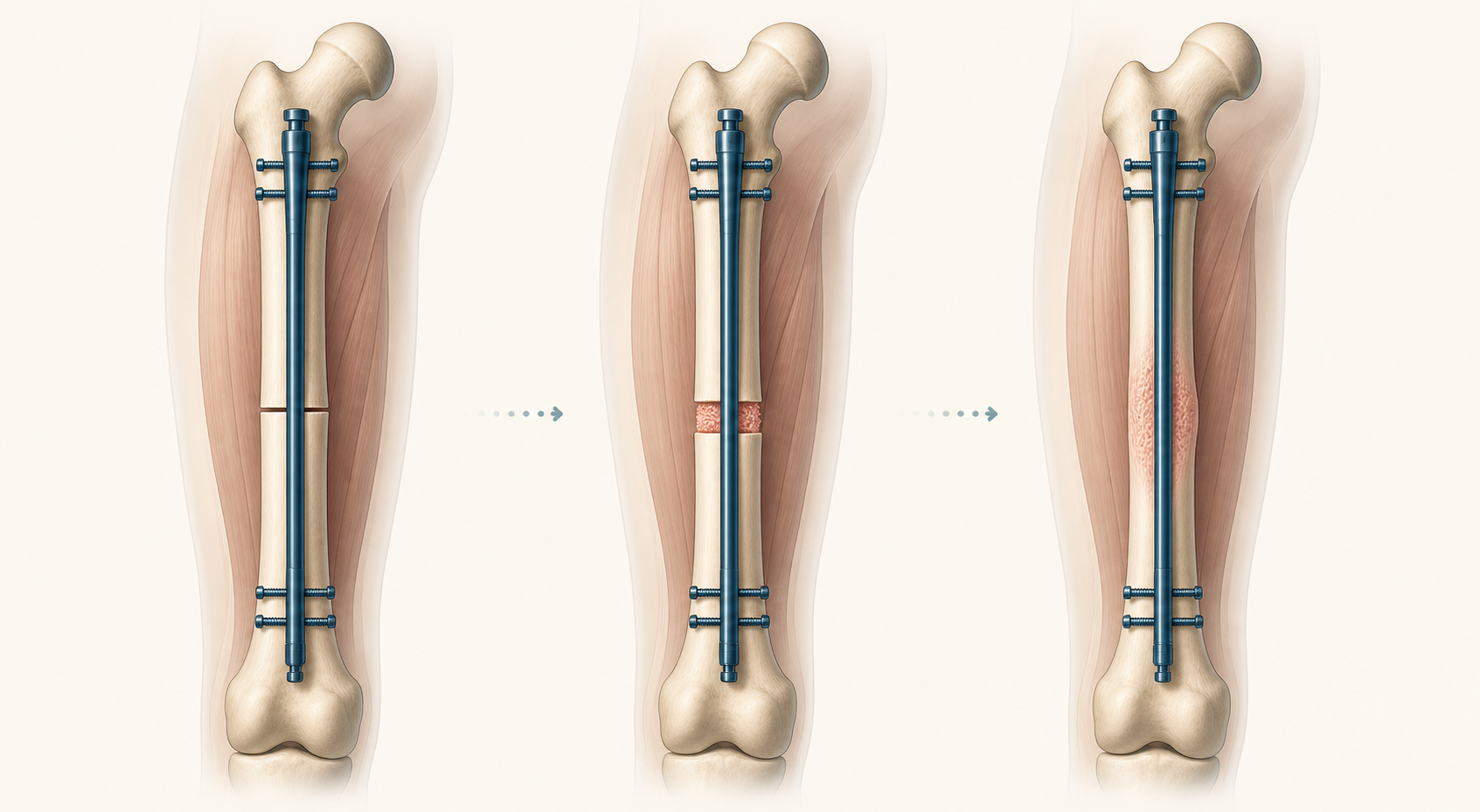
A target alone omits the bone, indication, soft-tissue tolerance, alignment, device limit, allowed weight bearing and rehabilitation capacity. The complete treatment continues after the active lengthening phase while the new bone hardens, and timing varies by patient.
Methods, devices and risks
“Internal is better” is too simple. An internal nail avoids external pin sites, but has device and removal constraints. External fixation remains an alternative when the treating team considers an internal nail unsuitable.
| Question | External fixation | Motorized internal nail | What evidence can say |
|---|---|---|---|
| Where is the device? | External frame. | Lengthening nail implanted inside the bone. | NICE intramedullary-distraction guidance describes both pathways. |
| Distinct burden | Pin-tract infection risk, frame care and day-to-day practical burden. | The treating team must determine whether the nail and its device rules fit the patient; implant problems and later removal are possible. | Pediatric Orthopaedic Society of North America guidance and the Royal National Orthopaedic Hospital guide give complication context. |
| Weight bearing | Not a generic promise. It depends on the fixation method, bone, treatment phase and whether X-rays show that new bone has hardened enough. | NICE intramedullary-distraction guidance | |
A 2024 meta-analysis of 10 retrospective comparative studies reported fewer problems, complications and total adverse events with motorized intramedullary nails than alternative techniques. The studies were non-randomized and heterogeneous, so this finding cannot select a method for an individual or prove one provider is better.
The US Food and Drug Administration’s 2023 update says titanium Precice Intramedullary Limb Lengthening use was expanded for femur and tibia lengthening in patients older than 12, reminds clinicians to remove the device after one year, and says stainless-steel Bone Transport, Plate and Stryde devices remain recalled in the US. This is US regulator information for named devices—not a claim about every nail or country approval. Ask for the exact manufacturer, model, material and local regulatory status in writing.
Bone & implant
Delayed or inadequate new-bone formation, loss of alignment, nail or screw problems, refracture and unplanned surgery.
Joint & soft tissue
Severe tightness (contracture), stiffness, joint instability and possible need to slow or stop lengthening.
Nerves, vessels & blood clots
Nerve or vessel injury, a clot in a deep vein or lung, and acute compartment syndrome—dangerous pressure building inside a muscle compartment.
A 2025 systematic review of aesthetic limb lengthening included 12 historical studies and 760 patients, with average reported lengthening around 67 mm and high satisfaction alongside infection and bone-healing complications. We classify this result as PARTIALLY VERIFIED because the study designs and outcome reporting limit certainty. It is not a clinic success rate and should not set your personal target.
Independent limb-lengthening programs and Bookimed-listed profiles
We first map programs and specialists from hospital, university, society, regulator and publication trails outside Bookimed. We then add source-backed Bookimed profiles where they exist. Neither layer replaces the other, and a public profile never proves current availability for your case.
External research: international programs
Hospital for Special Surgery Limb Lengthening and Complex Reconstruction Service
The Hospital for Special Surgery page observed on 16 Aug 2026 described adult and pediatric limb lengthening and complex reconstruction, a defined team and a surgeon roster.
- What the page says: the hospital describes this service and roster
- Confirm before booking: case fit, current access, quote, device and rehabilitation logistics
Royal National Orthopaedic Hospital Limb Reconstruction
The hospital service page observed on 16 Aug 2026 described limb reconstruction, and the hospital publishes a detailed patient guide.
- What the pages say: the hospital describes this service and patient pathway
- Confirm before booking: current private/international access and case fit
Programs in Hannover, Aachen and Munich
Pages observed on 16 Aug 2026 describe relevant capabilities at Hannover, Aachen and LMU Munich.
- What the pages say: the universities describe reconstructive or deformity capability
- Confirm before booking: exact technique, surgeon, international intake and timing
Provider pages requiring live operational confirmation
Acibadem’s provider page describes limb-lengthening capability. Medical Park publishes relevant surgeon scope. A Bookimed clinic page observed on 16 Aug 2026 included limb lengthening in the VM Medical Park Pendik treatment list.
- What the pages say: provider claims and an observed Bookimed listing—not a confirmed current relationship
- Confirm before booking: Bookimed relationship, surgeon assignment, exact device, package and procedure availability
External research: official hospital surgeon profiles
Public Bookimed profile listings added after independent discovery
These public profiles are visible alongside—not instead of—the external research set. A listing is not proof of a current Bookimed relationship, live procedure availability, personal case fit, volume, or outcomes.
 Fırat FidanMedical Park · provider lists orthopaedics, deformity and stature-lengthening focus
Current Bookimed relationship, availability and case fit: reverify.
 Burak TunaVM Medical Park Pendik · Bookimed profile displays a limb-lengthening package
Availability, case fit, personal volume and outcomes: not established by the profile.
 Bahtiyar DemiralpMedical Park Antalya · Bookimed profile lists limb lengthening among services
Availability, case fit, personal volume and outcomes: not established by the profile.
 Kayhan TuranTuran Turan Health Group · Bookimed profile displays limb-lengthening packages
Availability, case fit, personal volume and outcomes: not established by the profile.

Cost, travel and case-review checklist
Price is the most frequent theme in the analyzed requests (41/69, 59.4%). The useful answer is not one headline number—it is a comparable package tied to the same indication, bone, method and recovery plan.
A quote should state all of this
A 2026 UK referral series included only seven selected patients—too small to estimate risk—but all required physiotherapy and two needed major corrective surgery after treatment abroad. Use it as a warning about handoff design, not a complication rate. Read the 2026 limb-reconstruction health-tourism study and pair it with the full Royal National Orthopaedic Hospital recovery pathway.
Clinical file
Recent imaging requested by the treating team, prior imaging and surgery reports, diagnosis, treatment goal, medications and relevant health history.
Questions for surgeon
Why this bone and method? What would make you reduce or stop distraction? Which outcomes do you track for cases like mine?
Continuity map
Name the local physiotherapist, imaging cadence, remote-review owner, emergency route and post-return specialist before travel.
Browse sourced programs with one comparison checklist
Use the checklist above to ask every clinic for the same inputs, package fields and follow-up plan. Bookimed does not determine candidacy, select the procedure or validate a clinic’s treatment recommendation; the treating surgeon must do that. This candidate page itself does not collect or send your data, and the link below opens a clinic-listing page rather than a personalized comparison.
How this guide was researched
For every result we reviewed, we recorded the search, source, date and one decision: use it, hold it for more verification or reject it. Each source we used is tied to a specific statement, profile, page section or follow-up check.
Evidence hierarchy
Clinical claims use regulator, national guidance, specialty-society and peer-reviewed sources. Official hospital pages verify current programs and roles only. Provider and Bookimed pages never become independent clinical outcome evidence.
Bookimed Insights privacy
A read-only internal query selected requests assigned to this procedure and excluded records carrying the internal “waste” status. Patient-authored text was scrubbed, classified by an automated language model in temporary processing and discarded. Durable output contains aggregate counts, the number analyzed, window, method and limits—no raw chats, quotes, contacts or private identifiers. Theme coding was not human-validated.
Editorial and medical standards
The Bookimed Editorial Policy describes source analysis, medical-editor verification and readability review. Bookimed also publishes a Medical Advisory Board page as an organizational expert-review governance surface. This page does not currently record a named, page-specific medical review or editorial sign-off, and it is not a personal medical recommendation.
What we deliberately did not claim
No “best doctor” ranking, global market size, success rate, universal safe height gain, current fixed price or guaranteed Bookimed availability. The public page counter and an older price range were held because their method/freshness did not match the CRM cohort.